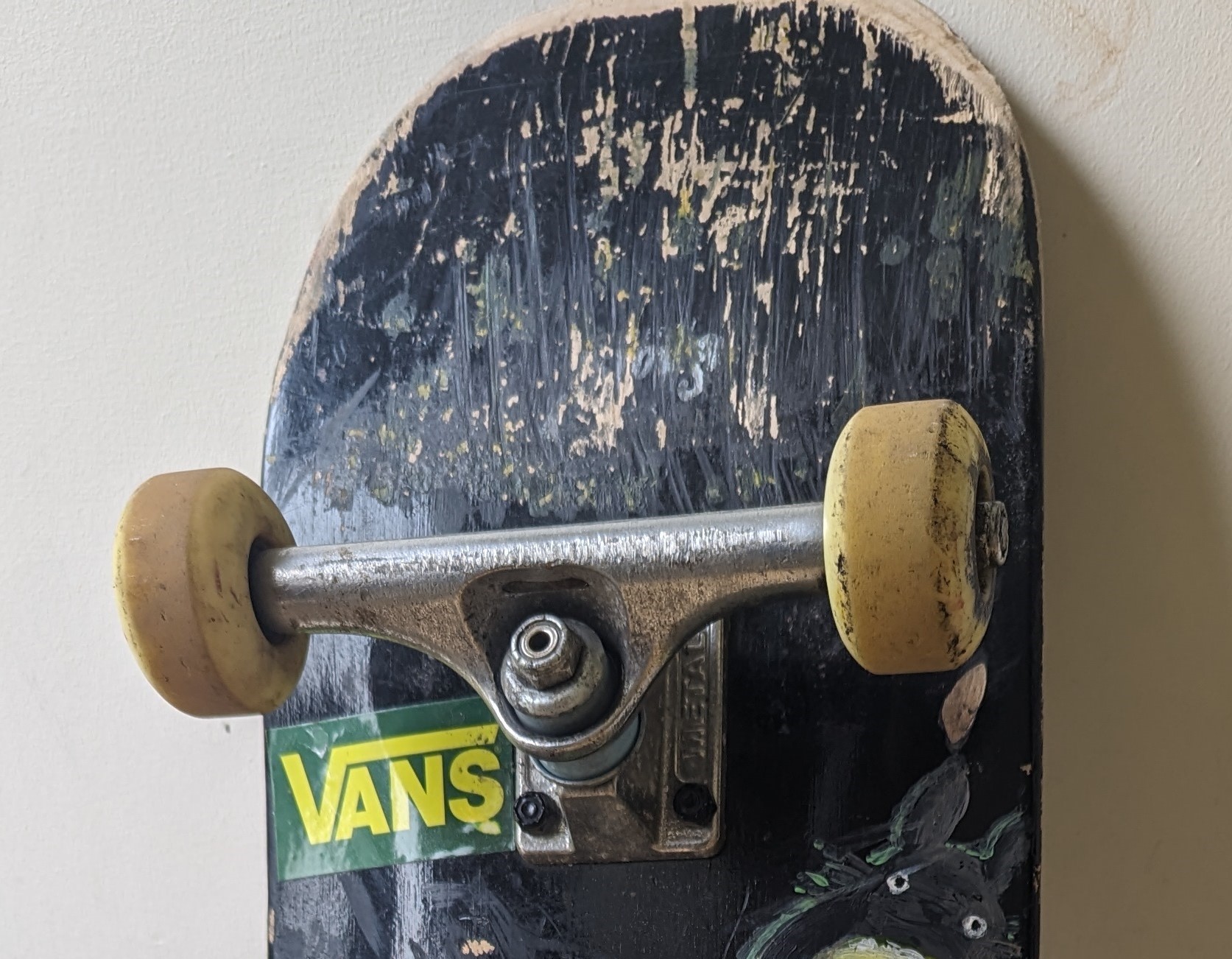
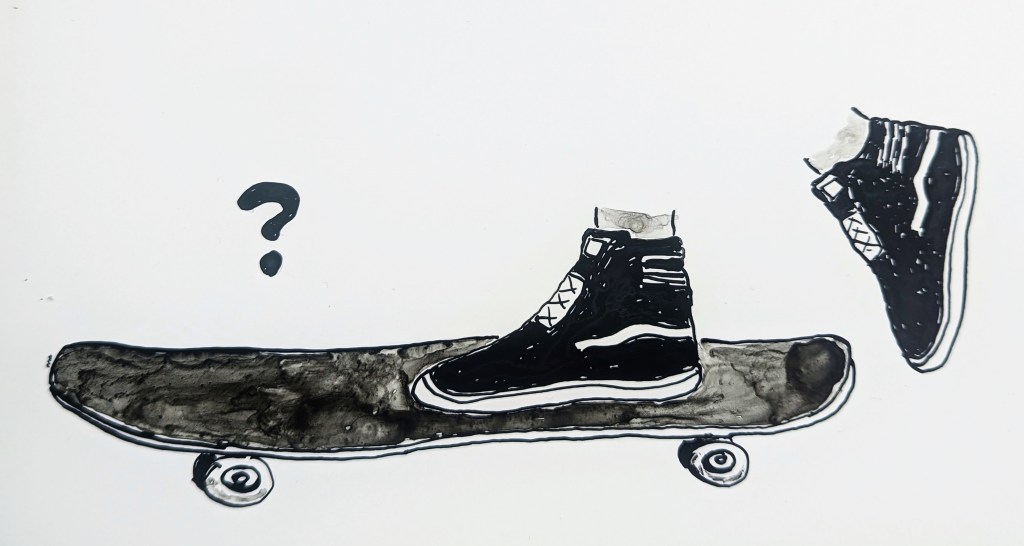
The year I learned to drive a car was also the year I learned to ride a skateboard.
As if one thing led to the other, I bought my first board just weeks after my first driving lesson. A pattern soon followed: driving on Thursdays; skating on Sundays. For several months, this became the rhythm of my life.
Later that year the driving lessons stopped.
The skating remained.
That same year, I turned 52.
This is a blog about that experience: about what it means to try something new, at a time when some – some – might say you oughtn’t, and when even your mind and body say you shouldn’t. It’s about learning to skate when you’re already pushing well into middle age. Why that’s a challenge, but also an education.
And also, I should add, one of the greatest things I’ve ever chosen to do.
But it’s also, inevitably, about lots else. Because skateboarding, as I now know, is about so much more than standing on a fast-moving piece of wood (although it’s all that too). Like any skill that requires a lot of work, including just staying on that same piece of wood, skateboarding asks of us both what kind of person we are, and the kind of person we want to be.
I’ll be saying more about this in coming posts. But I won’t get ahead of myself.
First things first: since this is a kind of introduction, I need to establish a few things.
One: Some people have said I remind them of Tony Hawk.
This would be flattering if it were even vaguely true, but it’s not. Not at all. Superficially, perhaps, at best. We’re both lanky (he’s a few inches taller). We both have greying hair (mine, if anything, tipping towards white), and I guess my face, on a really good day, could also be described as aquiline (I admit Hawk is better looking). But that’s it.
If people have ever said I look like Tony Hawk – and by ‘people’, I really mean ten year-old boys on scooters – it’s only ever because I’m standing over the coping with a skateboard, looking down at the drop, not unlike the great man himself. Not unlike the way the fortysomething blazing through ‘Seven Nation Army’ on Guitar Hero looks like (and maybe feels like) Jack White. It’s the sight of someone approximately the same age, doing something approximately similar… which in reality is not similar at all.
For one thing (second point): for the longest time, I pushed mongo.
Still reading? Good, since that means one of two things: either you don’t know what pushing mongo means, or if you do, you don’t care. Either way, that makes you my kind of reader.
For anyone who doesn’t know, to push mongo is a skating term meaning to kick with the ‘wrong’ foot, i.e. the foot that should be placed on the front (‘nose’) of the board. Which means that, when mongo pushers push off on a flat surface, the foot planted on the board is actually towards the rear: the opposite of where it needs to end up.
Why is this such a problem? Well, at best, from what I can gather, doing this is just a bad look, like you’ve got clown feet; at worst (and as the internet will remind you, in harsher terms), it’s a sign you’re totally clueless. Or as one skateboarding manual more politely puts it, mongo pushers are ‘lefties from the middle ages’. I’ve no idea what that actually means, but I don’t think it’s a compliment.
I do get it, though. Aesthetics aside, since it means you kick off with your ‘weaker’ leg, pushing like this is also inefficient and counter-intuitive. It places your weight more to the rear of the board, which lessens momentum, and is actually more dangerous, since the tail of the board can tip up. And since your front foot starts at the back, once you’re moving, you have to do a little shuffle to get set up.
Which also means that, by the time your feet are in the right place, it’s often already too late. And as for that vital, extra push-kick at speed, when you need it? Not going to happen!
I’m happy to report, after months of acquainting my body to do the opposite of what it originally wanted, I no longer push mongo (yey!). If it weren’t for the casual offensiveness of the term, though, pushing mongo would have been an apt name for this blog. Not because this is a blog about skating ‘wrong’. Rather, because it’s about the process of finding your own way, however you get there, and why this matters.
And it’s also about failure.
To be clear: I don’t have an author deal for this blog (I’m not really that kind of writer). No one’s sponsoring me. There’s no professional coach guiding me every step. Even if I wanted to, my day job stops me from skating more than once or twice a week, at best, so my progress is slow. And the footage of it won’t be worth making an appearance on YouTube or TikTok anytime soon.
In short, nothing’s in it for me, apart from the fun writing about it, and the hope that you might be interested in what I have to say.
I know that this probably puts me out of step with the times (call me old fashioned – or just old: I don’t care). We live in a culture of getting things done, quickly: where tutorials wait at the tap or swish of a touchscreen: experts and enthusiasts showing you the steps to success; or newbies mapping their exponential progress from novice to dude, all in a matter of weeks! But even if I was able to show you all that, frankly, why should you care? I can’t teach you anything you can’t find elsewhere, taught by someone much better qualified than me. Most likely you can do it all yourself already. And even if you can’t, well, someone else merely telling you they can may be just plain annoying.
On this note, and to change the tone slightly (but also to give an indication of where this whole thing might go): I recently listened to a conversation with Suleika Jaouad, author of, among other things, a celebrated New York Times column about living with leukaemia. For Jaouad, the problem with most memoirs about sickness, those that frame the story as a heroic personal journey, is that they are written from the point of view of health; of illness confronted, battled and defeated. What might that offer, Jaouad asked, for those that are still battling, or for those who, like her, are condemned to a life in the trenches? What story, in other words, do we tell about not getting well?
My own concerns, at least those relating to this blog, fade into nothing compared to Jaouad’s. Even still, Jaouad’s observation reminds us that the process, and the experience of living through something, might in the end be all we have to talk about. Success, like wellness, is just one possible destination, but we do the opposite a disservice if we erase it from the story.
Which is why we need to talk about failure as much as getting it ‘right’ – because failing is, after all, what most of us do most of the time, especially when we’re talking about something as difficult as skateboarding; and especially still at an age when the body’s resistance to wear and tear is on the decline, and when the brain’s neural pathways are that little bit less amenable to change. Or when, for that matter, a little voice in your ear is telling you that maybe you shouldn’t be doing this at all.
My own skateboarding story, so far at least, is not so much a story of success, than one of occasional achievements. It’s a story of imperfection, but it’s also my story, and in this blog, this is the point I want to make: that what really matters in skateboarding, like any discipline or art form, has nothing to do with nailing all the right moves, in the right way, and at the right time. What really matters is the process and what it teaches you. What you get out of it, in other words, and not how it might look to anyone else.
And if that appeals to you, or you happen to be in a similar boat to me, I invite you to join me on this little ride.
Even if you do push mongo.

 More Than Coping
Leave a comment