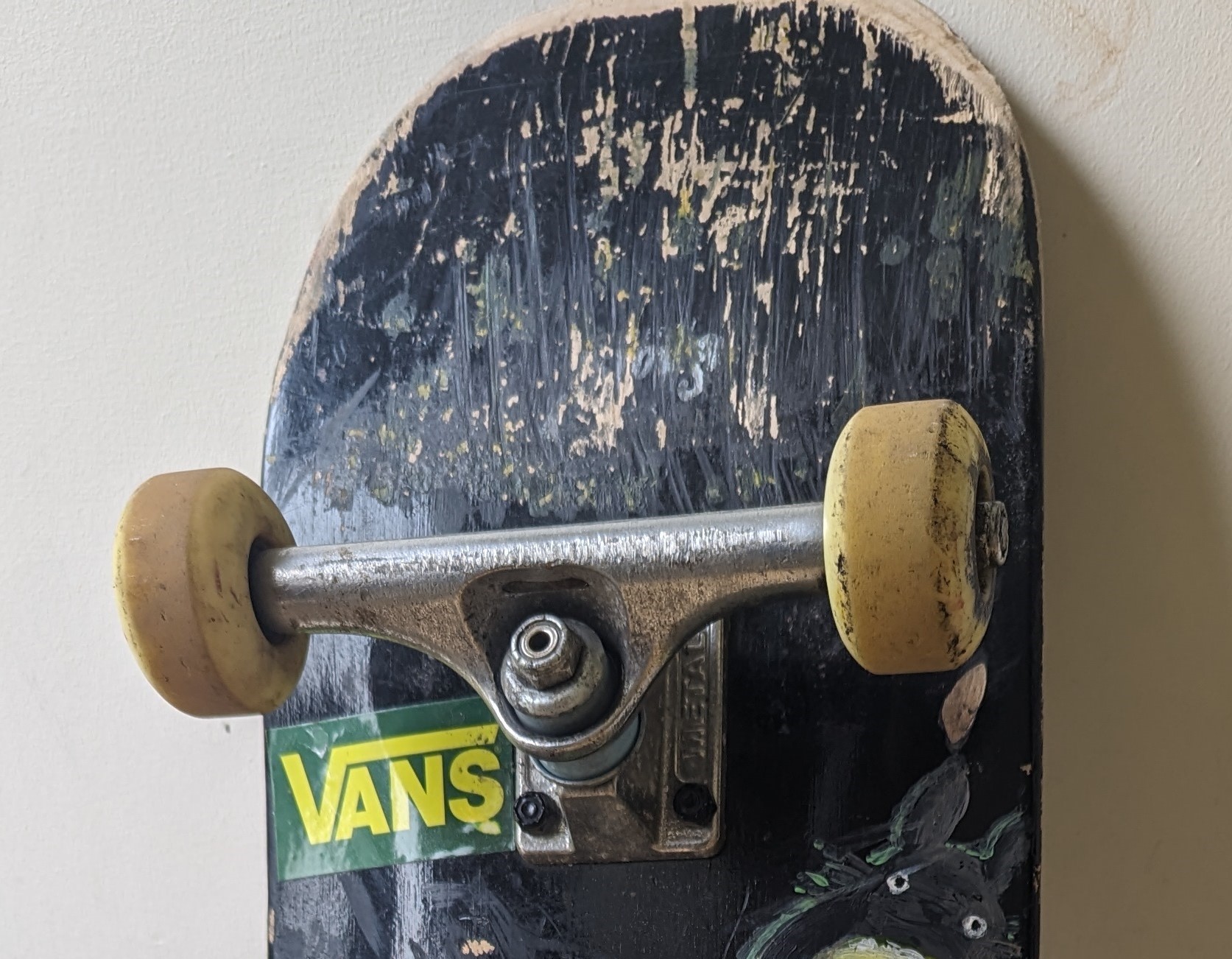
Since this is already my third post, it’s probably high time for a confession:
Learning to skateboard wasn’t my idea.
It’s not that I’d never been interested in skateboarding. I’d always liked skate culture, its styles, and its vibrant designs. I’m fascinated by the idea – one I’ll come back to at a later point – that skating, like other urban sports such as parkour, is something that can actually rethink and reshape the place where it’s practised. On all these points, I was sold. It just hadn’t occurred to me that I myself might actually get on a board.
And if it hadn’t been for my daughter, I might never have done so.
I don’t know why my daughter suddenly took up skateboarding at the age of twelve and a half. She isn’t sure either, but then it’s children’s roles to try everything, whatever it is, and see what sticks. In any case, when she told me she wanted a skateboard, and though it had never occurred to me to say this in forty years, my first thought was: Yes! I want one too!
In its peculiar way, getting older can be liberating, for a number of complex reasons. Maybe it’s that heightened sense of decline and remaining years – things I talked about in my previous post – that prompts older people into doing things they’d never have entertained in their earlier adult life. Or perhaps it’s the freedom that comes from no longer being ‘young’, and therefore no longer being subject to the scrutiny and judgement of that difficult age: too old to be ‘cool’, ironically, you can finally embrace all the cool stuff (something Carl Honoré, whom I also discussed previously, writes about at length in Bolder).
But children are liberating too, giving parents and other caregivers the opportunity to take part in things they might otherwise, for obvious social reasons, hesitate to do. As Tom Vanderbilt has pointed out in his book Beginners, taking an active interest in your child’s activities is a practical and more entertaining response to what is basically a necessary chore. But it’s also a way to avoid becoming one of those phone-scrolling grown-ups waiting for it all to be over (as Vanderbilt puts it, ‘If you have to take ’em, join ’em’). On the face of it, this sounds convenient – the notion that the dad diving into the ball-pool at a kid’s party gets to do so because he’s got a ‘pass’. And yet, why does he do it at all? Isn’t it the realisation, or even the revelation, that doing so is really great fun?
Getting involved with our children’s activities can remind us of things we once liked to do, and legitimate, in our supportive role, our doing them all over again. I’m cautious about this nostalgic line of thinking, though. By itself, that way of seeing binds us to a view of the world as circular, where the role of the child is to simply re-create for the adult a lost childhood or adolescence. I’m wary too of the sense that, in actually trying to do the good parental thing – in shepherding your child through whatever activities they choose to do – you firm up the assumption that you, indeed, are the shepherd, the guide, the one who knows.
What happens then when these things we do are, in fact, something we never did, or something about which we know nothing? Something, more to the point, that isn’t simply fun (jumping into a ball-pool) but is actually not only hard, but also really scary (in Vanderbilt’s case, surfing; skateboarding, in mine)?
It’s hardly news to say that raising children requires responsibility, but it’s also an act of deep humility. Alison Gopnik has described the role of the parent, metaphorically, as that of a ‘gardener’. As opposed to the ‘carpenter’, whose aim is to create something that ‘will fit the scheme [they] had in mind to begin with’, the gardener creates a space where things will flourish; some by purpose, but most by accident, unintended and unforeseen. It’s this capacity for unpredictable growth – a growth, also, we can’t fully control – that fuels evolution (what Gopnik delightfully calls ‘the generational human reboot’), and makes our children, well, not like us. Which, as every generation pushing against their parents’ might say, is entirely the point.
There’s an irony here, I know, since this suggests we just let our children be, rather than join in. But there’s a big difference here between the hothouse, helicopter-parenting Gopnik rejects and the act of participation. That’s because in joining in, we take on the role of student.
As a fellow fiftysomething learner, I was always going to warm to Vanderbilt’s Beginners. But on reading it, I was sold more by the role his soon-to-be teenage daughter plays in the book: at first, that of someone to be guided, but who then becomes the guide, the master. Joining in, not just observing what they’re doing, acclimatising the body and mind to the very same activities and skills, becomes for Vanderbilt ‘a fascinating window onto [childhood] growth’. But more than that, the child can become ‘the teacher of you’. And that’s a powerful thing to let in.

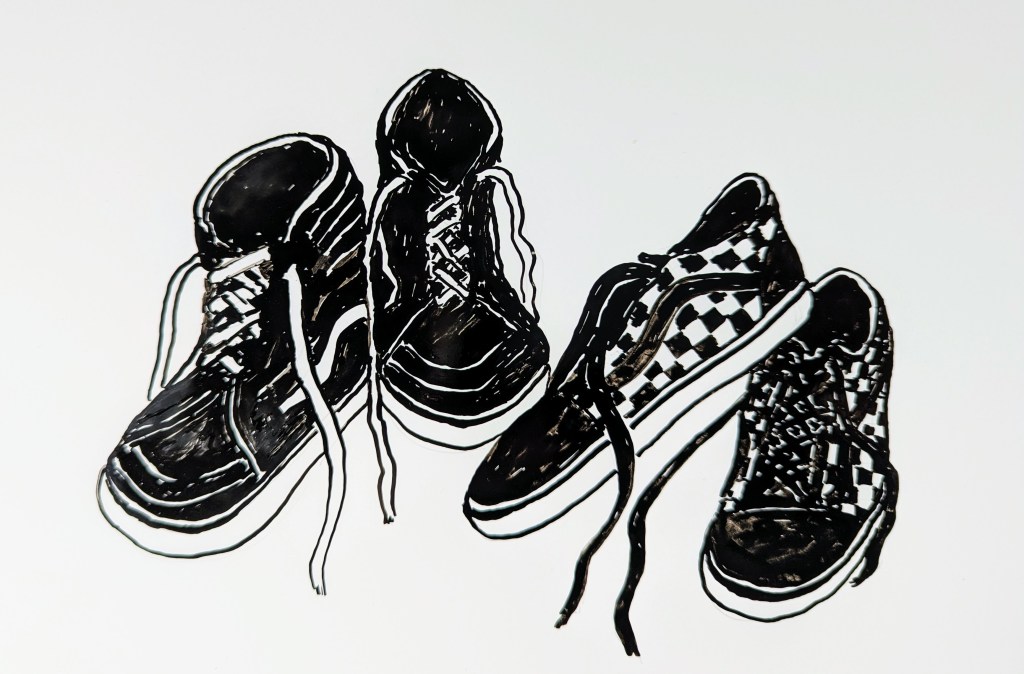
(Illustration by Noa Archer)
There’s a maxim by the French poet Arthur Rimbaud, on the last page of the last poem he ever wrote, that has stuck with me for more than thirty years: ‘Il faut être absolument moderne’: One must be absolutely modern. I’d never quite known what he meant, unless it was that we should avoid holding onto our past, and always accept and embrace change uncritically. The phrase sounds heroic, but it’s also deeply humble, insisting that we live fully and truthfully only when we give ourselves over to the fact that we know nothing: to the reality, in other words, of the generational human reboot.
Why did I start learning to skate in my fifties? Obviously, I don’t tell anyone it’s because I want to be ‘absolutely modern’, unless I want them to think I’m a prick, or at best, a bit nuts. But at some level it’s absolutely true. Not because it makes me cool (it doesn’t, believe me), but because in doing so, I give myself over to something totally new, over which I have little control. But also, because I’m putting myself in the place, and to some extent the tutelage, of a thirteen year-old girl. A girl who in skating terms, as with most things in life – and as it should be – is always one or more steps ahead of me.
 More Than Coping
Leave a comment