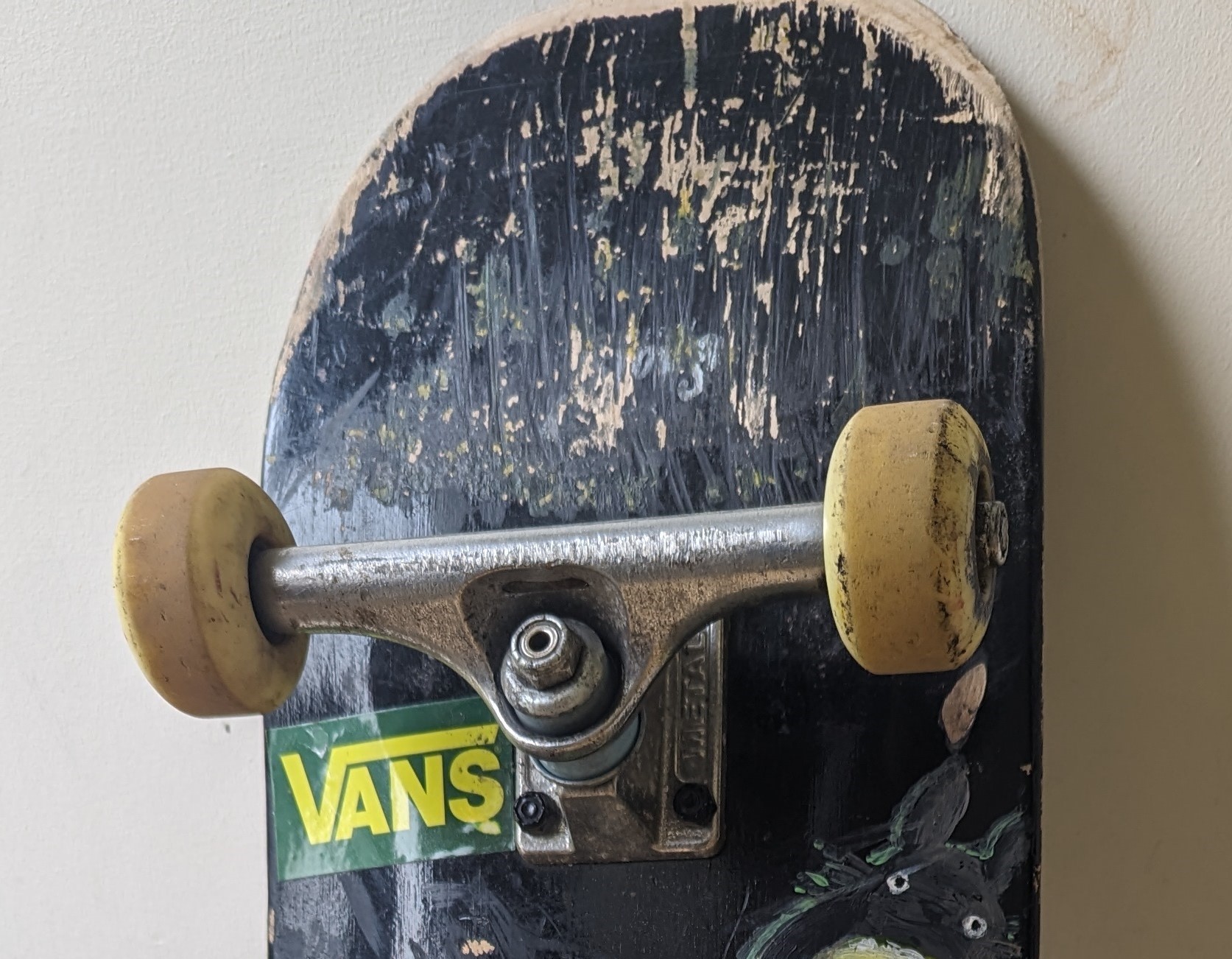

For some time now, I’ve been trying to nail the rock to fakie. For those less familiar with skateboarding’s peculiar jargon, this involves rolling up to the lip of a ramp, pressing the tail of the board so the front flops over the coping (the ‘rock’ part), then quickly pressing again to bring it back, along with yourself – now going back down the way you came, only in reverse (that is, in ‘fakie’).
That’s the description. In practice, it’s a quick, almost nonchalant trick, a nothing-special kind of tap-tap and down you go. Or at least, it is once you can do it. Because the reality of the rock to fakie – or rather my reality, which I guess it what I’m talking about here – is that it’s really, really hard.
I’m yet to complete a rock to fakie at the time of writing, but I’ve certainly failed it. I’ve probably failed it over a hundred times, in fact, which makes me something of a failure junkie; a poster child, if I were forty years younger, for rock to fakie non-achievement. By definition, in the lands of the rock to fakie, I am singularly without success.
Or maybe that’s not quite so true.
The challenges of the rock to fakie are at once technical, physical and psychological. Technical, in that you need to get to the coping with sufficient speed, but with enough control and finesse to delicately tap the board over the edge and then bring it back; physical, in terms of the readjustments of balance as you go first up, and then quickly back down the slope; psychological, finally, since the whole process involves the knowledge that you might fall – either as the board shoots out from beneath your feet, or the opposite, as you overbalance on the return and face-plant down the ramp.
In fact, no: the truth is not that you might fall, but that you almost certainly will. If you’re not falling, you’re either nailing the trick, or (in my initial attempts) bailing before you even try, allowing your back foot to come off the board and preventing the return drop altogether. To progress, I needed actively to tell myself not to lift that back foot. And that’s when I started to fall.
My daughter, of course, put this trick to bed months ago, and as she sagely tells me: it’s when you start falling that you know you’re getting closer.
To put that in slightly blunter terms: until it doesn’t, this is going to hurt.
My question then is this: How, if at all, does this knowledge change our understanding of ‘failure’ and ‘success’?
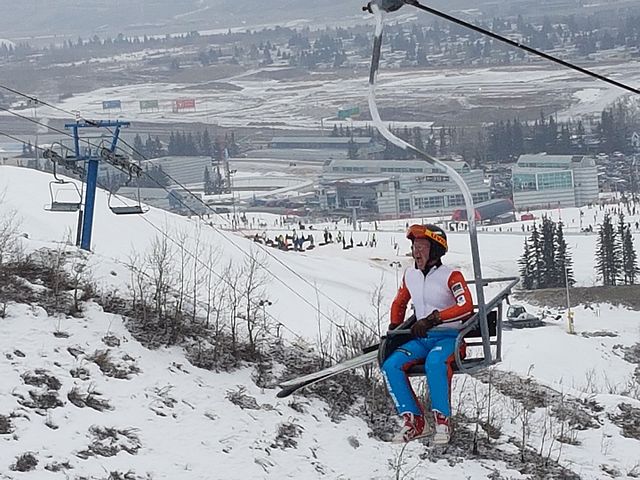
Michael Edwards is not a name likely to be found in any list of the world’s great athletes. If an alternative pantheon of sporting under-achievers exists, Edwards – better known as ‘Eddie’ Edwards, and better still as ‘Eddie The Eagle’ – holds a particular pride of place.
In 1988, Edwards took part in the Calgary Winter Olympic Games, Britain’s sole competitor in the ski-jump. This alone would make him a subject of curiosity, merely for the fact that Britain, at that point, never had competitors in the jumps, which were otherwise populated by an array of Finns, Norwegians, and other denizens of Europe’s snowy and more mountainous climes. Given such pedigree, it would hardly be surprising if Edwards did not figure on the Olympic rostrum. Yet Edwards was fated for something, in its way, far more eternal.
It’s one of the cruelties of elite-level sport that the entirely respectable mediocrity of a mid-table Olympic finish would have ensured that no one, beyond family and friends, or the most ardent ski-jump enthusiasts, would ever have mentioned Eddie Edwards’ name again. But as it turned out, Edwards would not just finish in last place, but last by a considerable margin. And since sporting history remembers extreme failure more than it records marginal defeat, Edwards would be enshrined forever in sports lore; perhaps the only Olympian ever to have finished last and still get both a namecheck in a Closing Ceremony, and a hit movie made about them (2016’s Eddie the Eagle).
It probably didn’t help (or did help, depending on how you want to spin it) that Edwards seemed physically such a gift to the creation of his own anti-sporting legend. In the less body-image sensitive days of the 1980s, I’ve no doubt the slightly patronising endearment Edwards generated stemmed from the fact that he wasn’t a flame-haired Scandinavian mountain god, but looked more like – well, like the plasterer’s apprentice from Gloucestershire that he actually was. Yet nothing, not the slightly jutting chin, nor the less-than-athletic body squeezed into Lycra, quite encapsulated Edwards’ comic persona than his glasses: at once thick and oversized, and all the more conspicuous for being worn inside a set of goggles.
Edwards was neither the first nor last short-sighted Olympian, but there was something about this overt signalling of his myopia that amplified just how amusingly ill-equipped he was for his task. Ski-jumping is, after all, a contest of vast distances: from the small seat at the top of the ramp to its edge, and then to the spot at the foot of the hill way, way down below, where you have to stick the landing. Despite the fact that Edwards’ glasses, as any wearer knows, presumably helped him see really well, he still had the image of some kind of alpine Mr Magoo, a sporting disaster waiting to happen – one only confirmed by his occasional tumbles when the landing didn’t quite stick.
Yet Edwards’ fate was also to be derided even when he stuck the landing. There’s a YouTube video showing the BBC’s own coverage of the Calgary contest, comparing Edwards’ last-place jump with that of the gold medallist, Finland’s Matti Nykaenen. A split-screen shows Edwards, after about three and a half seconds hang-time in the air, slapping down onto the hill, while beside him, the spritely Finn floats on, gracefully touching down about three more seconds and nearly fifty metres further down the slope. Why the BBC of all institutions put this together isn’t clear – where was its loyalty?! – apart maybe from having a bit of a sneer at Edwards’ expense. Edwards had become a bit of a national joke: the Beeb knew it, and made sure we didn’t forget it.
Some critics at the time suggested that having an abject no-hoper competing alongside elite athletes threatened to make a mockery of the competition; a precedent for some car-crash, reality TV-type scenario. Following Calgary, rule changes ensured there’d be no more Eddie the Eagles for the time being. Yet such concerns, I suspect, do Edwards something of a disservice. Just as, in fact, chuckling at Edwards’ myopic attempts to be an Olympian betrays an even greater myopia – on the part of the chuckler.
Wind it back a bit and re-watch that YouTube clip, only this time, concentrate not on what happens at the end, but what happens from the start, as both men push off the bench and begin their descent of the in-run. Then, as the two accelerate to their maximum speed of nearly sixty miles per hour, and practically in tandem, both men straighten up stiff from the tuck, launching off the edge of the ramp, twenty feet over the crest of the hill and into that ungainly, splayed-legged lean so distinctive to the sport, which nevertheless controls their movement in parallel with the hill, before they make contact around a hundred yards further down.
Put differently: in making his hopelessly last-place jump, Eddie Edwards propelled himself down a slope until he was going faster than a galloping horse, tied to two slippery strips of wood, before hurling himself off a ledge as high as a house, maintaining his shape and form as he travelled the length of a football field. In doing so, and (it is often overlooked) breaking the national record in the process, Edwards did something no British man before him had ever done.
But more to the point: he also did something most of us would never even think to do, since if we were ever faced by the reality of it, we would literally pee our pants. For this achievement alone, and even had he never put his feet into ski boots again, it would still be fair to say that Edwards’ life had been wonderfully lived.
It’s for this same reason that we need to think of success and failure not in terms of records and podiums, and not just in terms of personal goals and satisfaction, either, but rather in relation to what is being put on the line. Eddie Edwards was a gift to the weirdly self-deprecatory world of British sports films because he was all those things ‘we Brits’ supposedly cherish – eccentricity, authenticity, failure – rolled into one package. Perhaps needless to say, in the meritocratic, fiscally-doped contexts of British sport, with its Lottery-funded targeting of Olympic medal-contenders, this image is a total fantasy (and to put it in context, the year Eddie the Eagle came out, Team GB won twenty-seven gold medals at the Rio Olympics; more than China, for heaven’s sake). I suspect the image presented by a film like Eddie the Eagle or, similarly, 2021’s The Phantom of the Open, about the famously bad golfer Maurice Flitcroft (another competitor who came a distant last), offer an endearing and affably unpretentious view of plucky amateurs cocking a snoop at those establishment men and robotic over-achievers running and ruining the whole show. Respective under-achievements aside, though, Eddie the Eagle is about the truly terrifying sport of ski-jumping, while The Phantom of the Open is about golf; a sport unique for the fact that the risk of serious injury is greater to spectators than it is to its players.
Eddie the Eagle at least understands that what Edwards did went somehow beyond the merely eccentric impulse, and into the realms of the genuinely heroic. There’s a sweet, and presumably totally made-up moment late in the film, just before Edwards’ last jump on Calgary’s 90m hill, when he encounters Nykaenen on the lift to the ramp. The great Finn holds out his two index fingers to make a narrow V-shape, explaining to Edwards that ‘you and I are like one o’clock and eleven o’clock. Closer to each other than to the others. Winning, losing – that’s for the little people. Men like us, we jump to free our souls.’
As unlikely as this exchange might be, I find it quite moving; not just for its lack of irony, but also for the simple fact that it’s true. Eddie Edwards knew he would not win, but he really did want to ‘free his soul’ by doing something extraordinary, and on the greatest stage. Why else would anyone propel themselves down a mountain on two flimsy planks, with no guarantee that you would even walk off the slope in one piece once you’d landed?
Edwards, then, may have come last. But nothing in his sporting career describes a failure, if, by success, we understand what it took every time he strapped on his boots and sat on that tiny bench at the top of a massive hill.
Similarly, any time that any of us strap on our boots, whatever actual or figurative shape those boots may take, we’ve already begun to succeed. Whether or not anyone else recognises it, we’re measured by the hills we face inside: not just the visible ones we’re seen to conquer.

 More Than Coping
Leave a comment