
The first time I properly ‘dropped in’ on a skate ramp was in September 2023. I know this because, in a rare exception to my general rule (of which more another time), I recorded it on my phone.
I’m standing on the top of the ramp, placing my board carefully onto the metal coping, looking for all the world like I’m laying a wreath (this already marks me as a novice: most serious skaters simply shove the tail into place with their back foot). Somewhat stiffly, I then bring my left foot into position, diagonal across the front screws, like I’d learned to do. Then I lean forward, pushing this same foot down. As the front wheels hit the slope, I wobble, but stay on, disappearing to the right of the camera I’d placed there myself about ten seconds before.
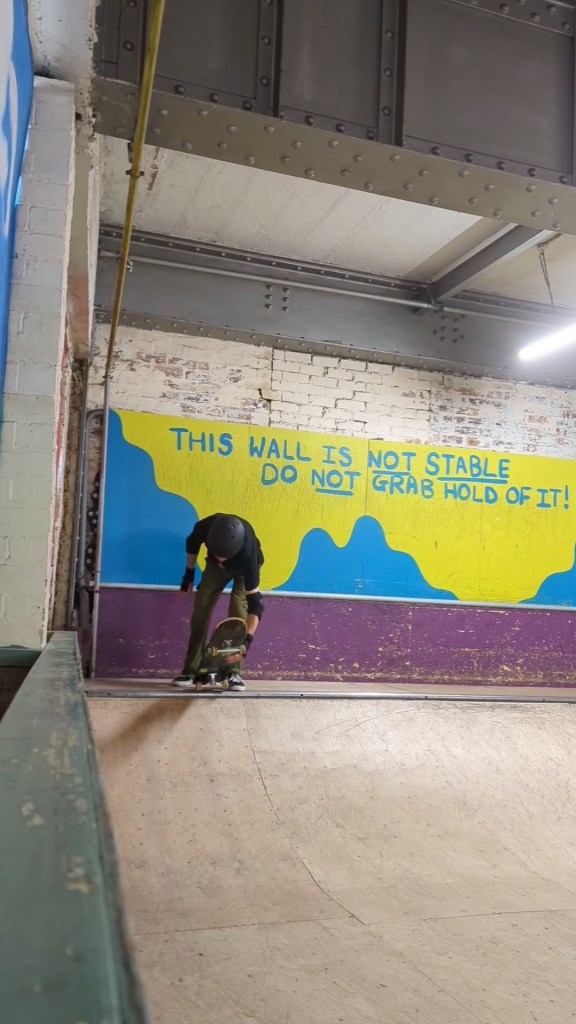
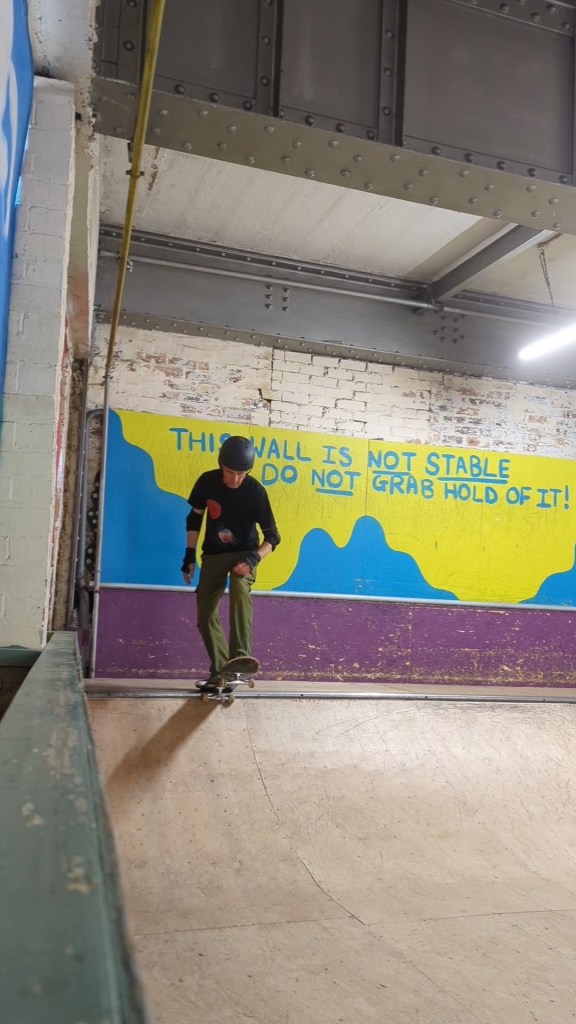
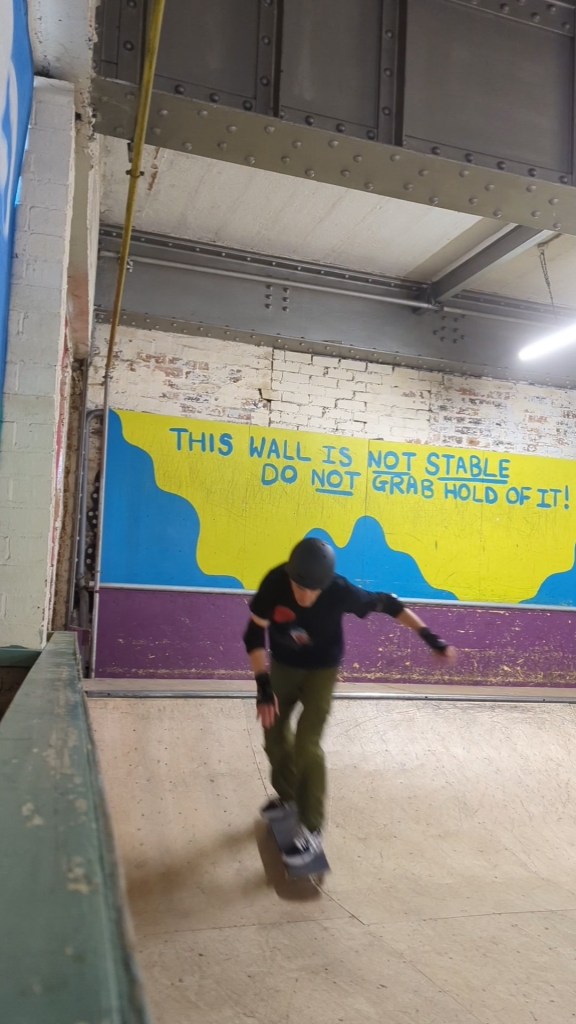
For some reason my daughter hadn’t joined me that day, which is why I recorded it: not so much to impress her (the ramp is about 30 inches high), but to impress upon her the fact I’d done it, knowing that she’d be surprised – not that I’d nailed it, but that I’d even tried it.
But why am I telling you this?
Dropping in is one of those things so fundamental to skating that for some it’s not even worth talking about. Like the ollie, it’s not really a ‘trick’, more a way to get going. A bit like starting a car, in fact. Only a car with no brakes. Down a hill.
Believe me, it does help to drop in. But it hurts.
Most opinion suggests that, from a technical point of view, dropping in isn’t all that complicated. Its difficulty, or rather its terrors – and videos abound showing newbie skaters becoming quivering wrecks over that same two and a half-foot drop – is mostly in the head. If, that is, you can call the reasonably legitimate fear of falling at pace onto a concrete floor merely ‘psychological’.
And that’s the thing: with tricks done on the ‘flat’, however difficult they might be, much of the challenge lies in trying out and then building up the requisite skills. But there’s no way to build up to a drop-in. As Yoda might have said, either do or do not: there is no ‘try’. Like landing a plane, it’s not something you can half-do, or do in stages. A failed drop-in ends at best with you running off the board. At worst, you’re sprawled on the floor with a new bruise. It’s not even like there’s a good way to bail. As someone once said (I forget who: maybe it was Yoda again?), the safest way not to drop in is… to drop in.
To many others – maybe anyone reading this who’s thinking why all the fuss? – this all comes much more naturally. My daughter, of course, picked it up after about eight hours on the ramps. For me, by contrast, it just wouldn’t… well, drop. That guy in the YouTube video above? That was me too, doing the skatepark hokey cokey, putting my left leg in-then-out. But even with the hesitation, the results were always the same: one or another variation of face- or butt-plant, culminating with a calamitous, wrist-scraping late-July tumble in Bishop’s Park’s otherwise very amenable little bowl. At which point, I decided enough was enough for now.
As I told my daughter that day: I’d do it again when I was ready.
Except that you’re never, ever ‘ready’.
In skating terms, learning to drop in pretty much does what it says. In a much bigger sense, though, the whole experience has taught me some important fact about readiness and its illusions – but also what to do about it.
That Sunday in September when I finally dropped in, I hadn’t gone there intending to try. The situation, as often happens, had just presented itself (the park was quiet; the ramp was free), and since I had no reason not to try, I’d found myself confronted by me own self-deception: the awareness that this state of ‘not being ready’ – something I’d been telling myself for the last eight weeks or so – was a perpetually moving feast. Next month, you say; and then, when the month comes around, you say it once again. I’ll do it when I’m ready.
As the psychologist Adam Grant discusses in his book Hidden Potential, saying you’re not ready is how we create and reinforce ‘comfort zones’. At worst, establishing your own comfort zone constricts and shrinks your possibilities, like a snake eating its own tail. It’s a piece of psycho-logic that justifies and forgives not trying. In order to master difficult skills or scary situations, we feel we need to have had sufficient practice; yet such is the challenge of these skills and situations that we rarely confront them until we feel like masters. Which, logically, unless we give it a go, will never happen.
For anyone in this fix, Grant’s suggestion is not so much that we leave our comfort zone, but that we don’t get there in the first place. The trick (to skate tricks), in other words, is to start doing them long before you feel either ready or comfortable, so that comfort and mastery arrive, as they necessarily must, at the same point. In any given skill, Grant suggests, ‘the best way to accelerate growth’ is not to wait for that always-distant, imaginary moment of comfort to arrive, but rather ‘to embrace, seek, and amplify discomfort.’
I’m struck by the similarities here between learning to skateboard at 52 and my parallel adventures learning to drive at the same age. Having passed my test at the first time of asking (a test for which I’d also told myself I was ‘not ready’), I was then confronted by the actually more fearful realities of buying my own car. Forget learning, or even the test itself: driving away from the showroom, alone in a car for the first time, is the opposite of a comfort zone.
A week of driving later, I felt myself prey to those same reassuring voices that told me I wasn’t ready to drop in: those telling me I wasn’t ready yet to go on a longer drive, beyond the familiar routes to the supermarket or my daughter’s school. The same weekend I’d bought the car, in fact, my daughter and I went skating, but the car stayed in the drive and we took the bus. The following week, I thought we might try a compromise: my daughter had an appointment in town, so why not drive to Morrison’s (well within my comfort zone) and then get the bus the rest of the way to the park? Job done, I thought, until my daughter pointed out the two-hour maximum wait time in Morrison’s car park. Shit.
By this point we had a choice to make: one, park up in the local NCP, wherever that was, and pay for the privilege of leaving it there; two, go back home, and miss out on skating altogether; or three, simply do what I’d been convinced I’d do only at a later point, when I was ready, and drive all the way to the damn skate park. Which is what, in the end, thanks in part to Waze, we managed to do, and without too much fuss. Later, and with significantly more fuss (and, I admit, some less than optimal driving), we got back in the dark and the rain. I’d done the thing that felt uncomfortable and made it that bit more comfortable. I hadn’t waited for my never-to-arrive comfort zone. I’d brought the comfort zone to me.
If not now, when? I know this sounds like a lost Smiths song, but it’s actually my recollected version of a maxim by the Stoic philosopher Seneca: When shall we live, if not now?
Or as I now understand it: when are we ever ready to take the plunge we fear to take?
Dropping in is more straightforward now, but remains challenging as it expands in scope, every increment in height feeling like I’m striving to do it all over again. On the morning of writing this, in fact, I was standing over the lip of a drop about a foot higher than any I’d tried before. Those twelve inches of near vertical extra drop groaned below me. It would have been easy, so easy, to put it off till the time was right.
But as I tell myself now, that time would never come. If not now, when?
I took the plunge.
 More Than Coping
Leave a comment