Let’s give it up for the Bert.
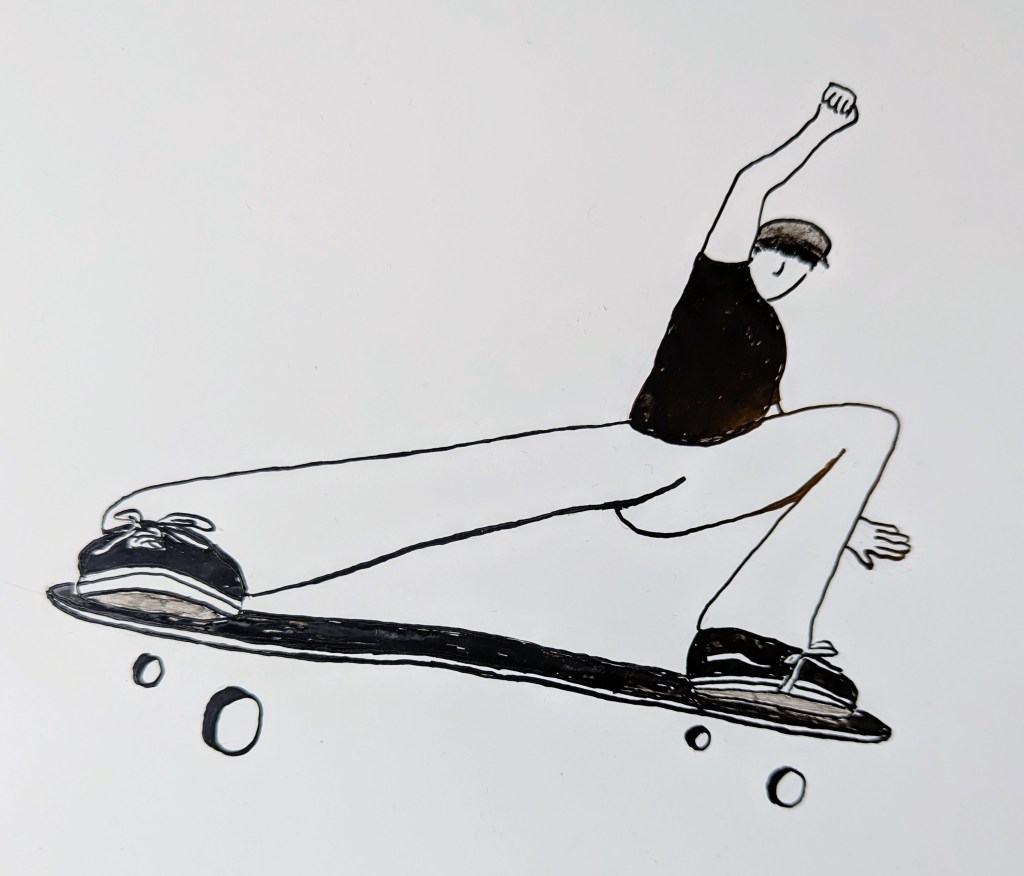
The Bertlemann slide, to give the move its full name, is a turn you make by crouching low on the board and placing both, or preferably just one hand on the ramp or flat. You then pivot around this hand, which generates a smaller arc in the turn: one you add to by kicking the back of the board, skidding it straight. You can do it backside (leaning forward and over the turn), though the real deal is to go frontside (leaning backwards, away from the turn). The goal is then to pull the board forward out of the turn using the rear foot, as you straighten up and ride away.
If this makes it sound dull, better just to watch someone doing it really well.
Let me be upfront about this: I love Bert sliding. For one thing, it’s a trick I can actually do pretty well: both frontside and backside, along with a backside 360 (‘Bert revert’), where you pivot a full circle and come out in ‘fakie’. Making this move my particular domain has also, I should say, kind of singled me out. Where I skate, at least, it’s not something often done. Maybe it’s too low-risk, not hard enough, who knows? Or perhaps its just seen as a bit… old school.
The Bert’s well-known origins lie in the influence of surf moves on skateboarding in the 1970s. It’s named after Larry Bertlemann, an Hawaiian surfer who liked to dip his hand into the wave as he carved: a technique he then employed in his skateboarding, and which also inspired the low-down, hands-on-the-ground style made popular by Dogtown’s ‘Z-Boys’ skating team. In part this adoption was practical, enabling the skater to make tighter turns at speed. But it was also an aesthetic choice: a way of bringing the look and feel of wave-riding to concrete flats and banks.
It’s hard not to think about this stylistic dimension, the way it might look, when executing Bert slides. It’s an especially lovely move, I think, even if I don’t know enough about aesthetic theory to understand why. Maybe it’s the fluidity of the turn that is satisfying. Or perhaps, like in some forms of contemporary dance, it’s the body in extension we find pleasing, especially when this extension is counter-intuitive. At its most extreme, the Bert involves pushing the rear leg as far away from the planted hand as possible. Maintaining this position and then pulling the skateboard forward again to meet the hand – and then continuing on, in perfect balance – seems so stretched, it can only be a thing of beauty.
At least, that’s what I like to tell myself. As I mentioned a couple of posts ago, especially when it comes to skating, I don’t often record the things I try to do. There’s an aspect of vanity at work here, I admit, since whatever I end up seeing on screen never quite adds up to my own internal impressions. The speed and extensions I felt in action simply don’t translate. By contrast, I look slow, oddly inflexible. Old.
Let’s call this the perception gap between subjective and objective vision. As Tom Vanderbilt writes in Beginners, about his experiences learning to surf, riding a seven foot wave in Costa Rica for the first time left him feeling ‘like Neptune, on some sea chariot’. Yet the shock of watching himself on video later that day brought him back to earth. ‘In the water,’ he writes, ‘I felt as if I were careening down the face of monster tubes. On the video, I looked like the “fun dad” in a kiddie pool.’
I know what Vanderbilt means from watching the rare clip I’ve taken of myself; where the sensation of racing down a ramp is reduced to a glorified trundle, and like Vanderbilt, my face is ‘knotted into a grimace’, my body ‘hunched over, all thin and bent’. The idea too of looking like the ‘fun dad’ is one I’ve also dealt with. I know for a fact that, the very first day I tried (and failed) the Bert, a pink-haired teen with a fondness for skating bare-chested was scoffing at my efforts on the other side of the park. I know this because my daughter was sitting next to him at the time, relaying to me later what she’d overheard.
I shrugged. He couldn’t have known who she was, and anyhow, it wasn’t like he’d said it to my face. And more to the point: what did it matter what he said?
What, indeed. Look again at what Vanderbilt writes: ‘To anyone looking from the shore, I was just another tourist… but I felt like Neptune… On the video, I looked like the “fun dad”… [but] in the water, I felt like I was careening down monster tubes.’ Vanderbilt may be striving to show how our impressions can be deceptive, but what he does, in truth, is show how what we feel is another order of experience: one that is in its own way is no less true – perhaps more true, in fact – than whatever is visible from the distant look of the observer, or through the narrowing lens of the video camera.

One of the blessings, perhaps, of taking up skating in your fifties is that there is much less social and peer pressure either to conform or to excel. Carl Honoré argues that the lessening of performance expectations in later life, and the diminished pressure to define your sense of identity, makes ‘living on [y]our own terms’ a much more appetizing possibility. Knowing this is also of course the product of age and wisdom; Honoré’s recognition that – as Lao Tzu once said – the pursuit of other people’s approval is a kind of prison. Liberation, by contrast, is not caring how you look.
But it’s a mistake too to think that the aesthetic experience is limited to what we see, rather than something felt in the body. The academic and skater Iain Borden has explored at length the particular notion of skateboarding as an evolving relationship between the moving body and the architecture of space: something best appreciated not by the distant observer, but by the skater in the act itself. Skating, Borden writes in his indispensable Skateboarding and the City, is ‘embodied experience’ and is ‘felt rather than seen’. Maybe some choose to skate for social media validation or all sorts of other props, but I suspect most of us do it first and foremost for the feeling it provides; for that moment of defying gravity, of moving without exerting force, and for the profound satisfaction of simply staying on the board. We do it not to look good, but for the ‘feelings of euphoria, emancipation, transcendence, absorption, tranquillity and an altered sense of time’ it provides.
Borden here evokes that experience of focused challenge and profound engagement famously coined by the psychologist Mihaly Csikszentmihalyi as flow. Applying such a liquid term to skateboarding is doubly appropriate, since it’s this same sense of flow I experience when Bert sliding, gliding through a series of fluid movements from ramp to ramp. In doing this, the oceanic vibe of surfing aligns with the peaceful feeling at the heart of an absorbing activity: a calmness and sense of inner beauty that feels just fine to me, and doesn’t need anyone else’s thumbs-up.
 More Than Coping
Leave a comment