Architecturally speaking, is there anything more dull than a car park?
Structures have many reasons to be standing, but it stands to reason they should serve the people they’re built for. We should expect them be easy to access, to leave, and fun to get around. They should provide comfort, calmness, or inspiration, allowing us to do our jobs, or just bide our time, in peace.
More than anything, though, we should expect architecture to be beautiful, since our relationship to it, at both a fundamental and logical level, ought to be one of pleasure. And maybe I’ve not travelled enough, but in my experience, car parks – or parking lots, outside my home islands – don’t serve this last function.
They’re the opposite of a park, for one thing, with all the various connotations of that word (the British term, to be grammatically precise, just describes what happens in them, like calling an actual park a dog walk or human sit). They’re also a visual blight, extending the concrete sprawl of modern cities, and filling once green land, like a grey slick. Built to house hundreds of vehicles at rare hours of high capacity, they are also, most of the time, empty: a literal waste of space.
To be fair to car parks, they don’t quite make the leap into the despised zone of ‘hostile architecture‘: those deliberately uncomfortable structures and pointless ornamental additions whose only point is to prevent people relaxing, or – as if often the case around public spaces – stop them from skateboarding. Yet car parks still seem to me deliberately ugly, as if, for their creators, the idea of them being otherwise is only laughable.
So why am I talking about them here?
The truth is, without car parks, my life would be evidently poorer.
For a large part of the year I live on the university campus where I also work; a scattered sprawl of postwar and later buildings, constructed in what was once (and mostly still us) a leafy country estate. One of the university’s reasonable claims to fame is its self-sustainability, sucking most of its energy from the wind turbines and solar-energy farms housed on its lands. A good job, in both senses of the term, since the campus – originating, for various reasons, on a hill in the middle of nowhere, with little public transport – also has to accommodate the several hundred cars now traveling to and from it every day.
Which is how I find myself surrounded by car parks.
The car park may be ugly, but its beauty to the skater is the moment when all that useless tarmac becomes the site of opportunity. Because skateboarding is about creating variations of movement in space, it’s best served by its opposite, in the form of the most linear, functional and rational architecture; neat, smoothly-paved squares, wide streets and civic buildings (which is also where you find most skate-stopping devices). These sites are a gift to the skater in the way, say, that cobbled medieval lanes most definitely aren’t. And the car park, designed uniquely to contain that most modern of vehicles in the least distressing way possible, might be one of the greatest gifts of all.
Sure, car parks lack some of the things that make street skating so rich: benches, planters, steps and rails. Nor do they offer much in the way of ramps. For the beginner, though, these aren’t really absences, and what you get instead is plenty of kerbing: great for simple-but-fun starter tricks like drop-offs and kerb nose stalls (both of which I did after a month on the board). And what you lack in variety, you make up in an abundance of space: space to ride, space to slide, to revert – room to work on jumps and flips, without having to worry about pedestrians, or cars for that matter, as long as you pick your time right.
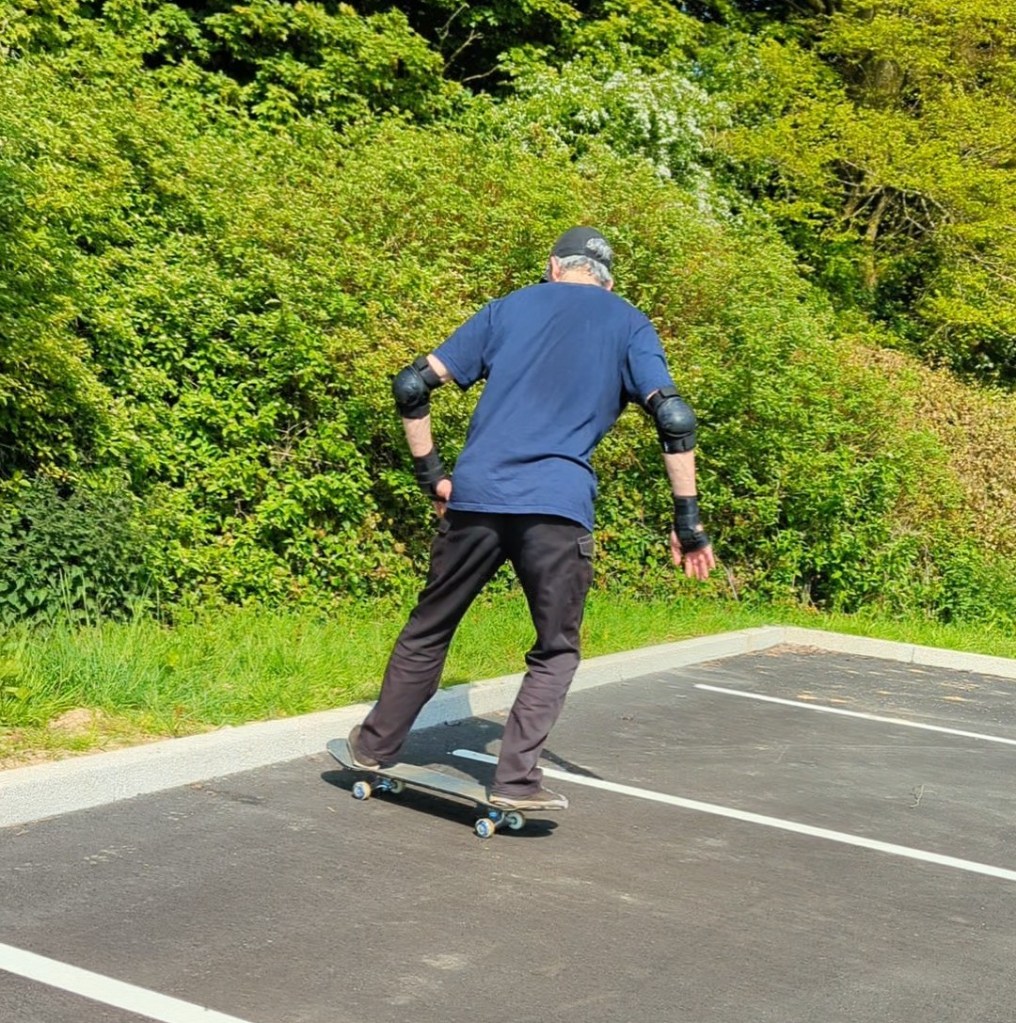

What I’m getting at here is that, like any kind of street skating, riding a car park is really a question of imagination. Taking a board into any space not ‘officially’ designated for skating is to creatively reinvent that same space for different ends: to take a kerb, for instance, not as a line separating where cars can and can’t go, but its own area, with dimension and possibilities. To turn the dull space of the car park into an actual park of play.
There’s a lovely passage to this same effect at the very end of Iain Borden’s Skateboarding and the City, which deserves being quoted here at length:
‘Skateboarding… offer[s] us not just a glimpse but a partially enacted vision of what a different world might be like. In this sense, as an entity born out of contemporary urbanism… skateboarding concurs with Henri Lefebvre’s enigmatic contention regarding the potential of cities. “Here, in the new town, boredom is pregnant with desires, frustrated frenzies, unrealized possibilities. A magnificent life is waiting just around the corner, and far, far away.”’
Skateboarding as a magnificent life. Stop to think about what this means, and the idea is not just hot air, since magnificent means not just to make great, but also carries with it the idea of making big – as in the related word magnify. Skateboarding extends the place we’re in without us having to go any further, at once and at the same time just around the corner, and also far, far away. Put like that, the otherwise grey swathe of the car park, at least in the skater’s mind, can become an ocean.
On which final note:
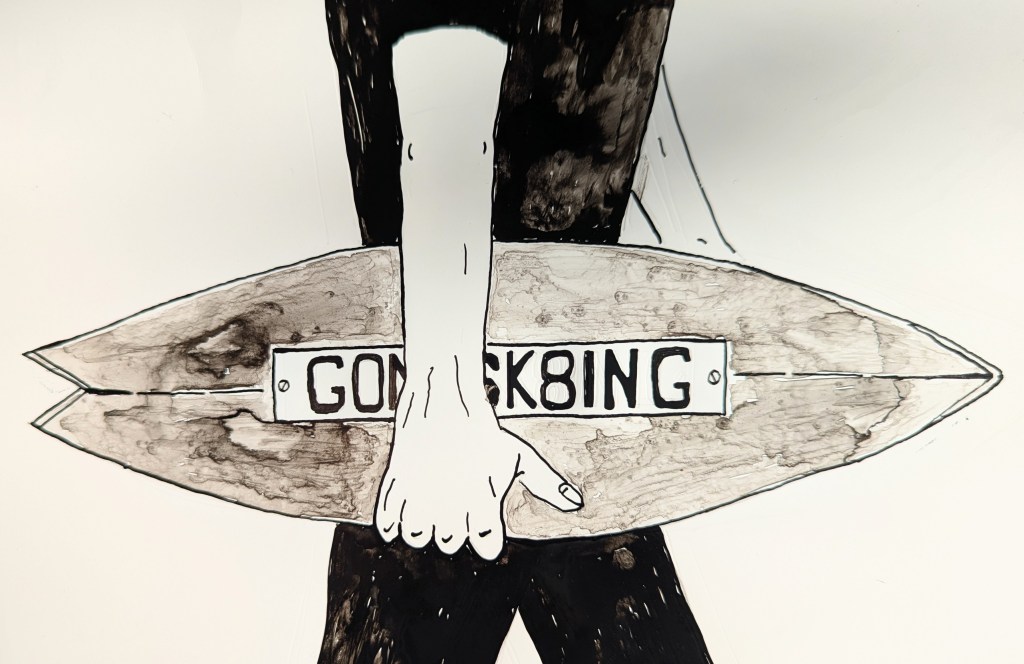
I’ve previously touched on skateboarding’s links to surfing, for which, at least in the California of the 1960s and 70s, it was at first a kind of dry-land compensation when the waves were bad. Yet the always-accessible quality of skateboarding, allied to the fairly obvious point that most people on earth don’t live by the sea, goes some way to explain skating’s unique distinction from its water-based precursor.
Skating a car park is not just a reinvention of asphalt from a surfing perspective. It’s also much more democratic: you might live as far from the ocean and on as flat a land as is geographically possible, yet with a skateboard, you can bring your own waves. And you don’t need a car to get there, either.
 More Than Coping
Leave a comment