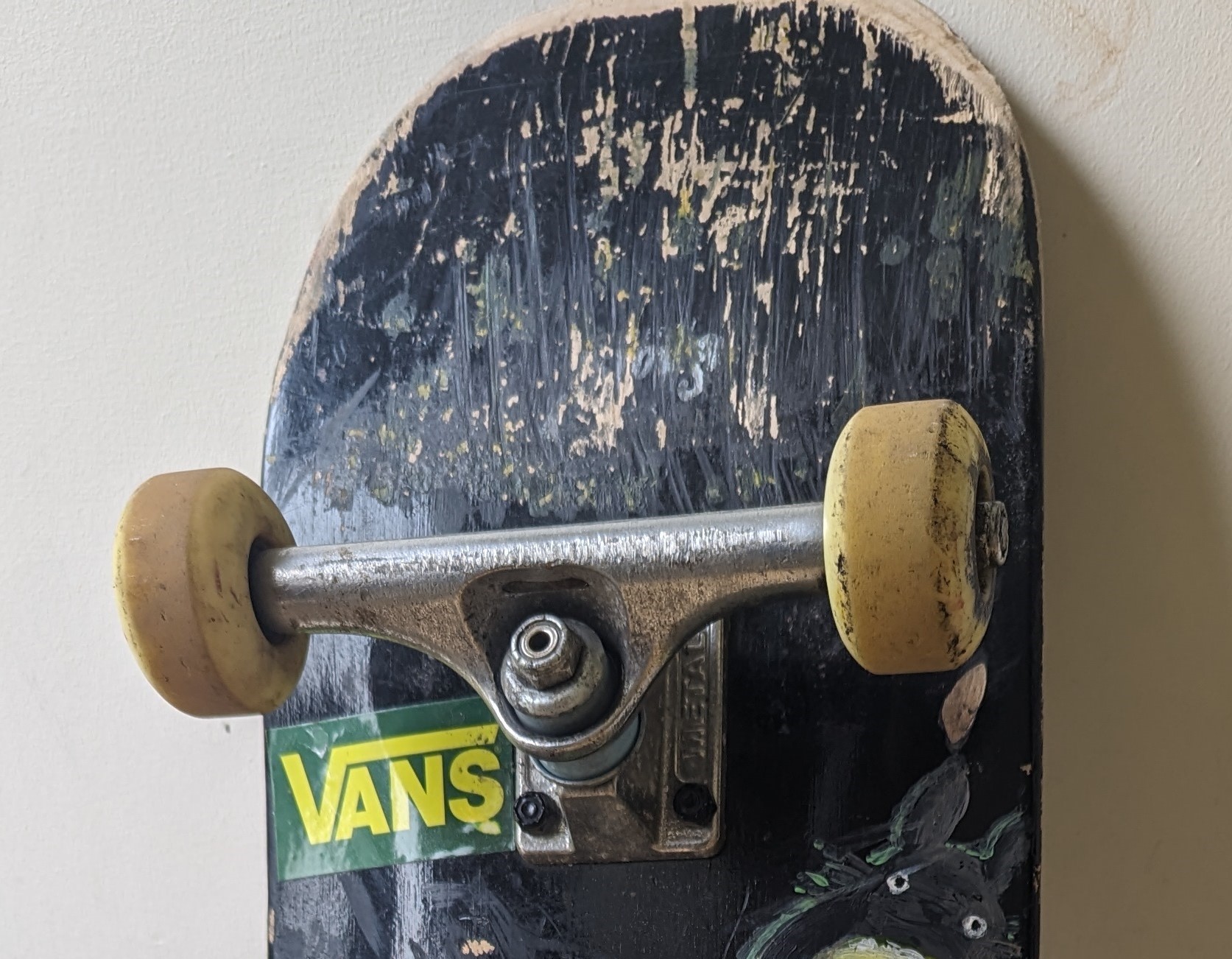

Skateboarding is writing is how the technology writer and skater Jeff Howe winds up a 2003 essay, ‘Drawing Lines’. I confess: reading that for the first time, I wasn’t sure what he meant. I’m not sure I do now. Like Howe, though, I have something of a foot in both camps, and what’s more – as I pondered in my last post – I find myself frequently asking where writing ends and skating begins… and then, where writing starts again.
The paradox I touched on last time around – an inevitable one, if that’s not too much of, well, a paradox – is that it’s writers who tend to thrash this same idea out in print. Without bigging myself up unduly, this blog is my own way of working out these same questions. A bit compulsively, you might have noticed – though needless to say, if I didn’t skate, I’d never be writing this in the first place. What, after all, would I have to talk about? Perhaps skateboarding and writing are simply two sides of the same coin.
Perhaps they can learn from each other.
The Japanese writer Haruki Murakami, author of novels like A Wild Sheep Chase and The Wind-Up Bird Chronicle. is definitely not a skater, but he is a runner: a very serious one, who for decades was running several miles a day, most days, and completing annual marathons, occasional ultramarathons and also triathlons. What I Talk About When I Talk About Running, which recounts his training for the 2004 New York Marathon, was written when he was 55, only slightly older than I am now. Since this is the space for confessions, I admit I spent nearly forty years hitting pavements in running shoes before I did anything similar on a skateboard. Let’s just say, then, Murakami’s book speaks to me.
Especially as, in truth, Murakami isn’t really talking about ‘running’ at all (hence the cryptic, teasing title of his book). What he’s really talking about is what he’s actually doing when he’s talking about running: writing. And why, in fact, writing and running – like, for Howe, writing and skateboarding – are so intertwined.
Murakami has noted that, to some at least, the marathon-running novelist is a bit of an odd concept. Writers of fiction aren’t supposed to be healthy. They’re artists, not athletes. They imagine stuff for a living. Oh, yes: and unless you’ve embraced the concept of the standing desk, the job involves sitting down all day.
Looking at words on a page for long parts of the day might be a description of the writer’s job, but as I’ve pondered before, it’s also part of the writer’s problem. Writing is a creative task, but you might also call it an unnatural one, sickly, even perverse. You stare at a screen or a sheet of paper for hours at a time, dredging words out of your head about things that, in the case of novelists, don’t even exist, or in the case of the non-fiction writer, are thoughts no one necessarily needs to hear.
From one point of view, Murakami’s running is his particular version of the ‘decisive action’ I talked about in my last post; that kind of immediate, all-consuming physical activity that writing both denies but also tries to stand in for. But there’s also, Murakami suggests, a good loneliness about running, and a deeply contemplative quality that suits a writer like him – because, he suggests, running is an extension of writing itself.
I know what he means. While I’m not discounting the possible socializing function of any physical activity, the reality of skateboarding – which, at its most immediate point, requires you to focus solely on your own body and board, and literally to think about nothing else – is that it is profoundly solitary. Which, to me at least, explains much of its appeal.
Skateboarding, so long as you set real and serious goals for what you wish to do with it, suits the person who is happy in their own company: a condition that also describes most writers. I’m a bit of a loner by nature, and deeply wary of playing team sports for many reasons, most of them best kept between me and my therapist. Mainly, though, at the core of skating’s solitary pursuit, and in contrast to those games played in a team, is something that – for want of a better word – we might call spiritual.
Adam Gopnik, in his book The Real Work, talks about American writers like Ernest Hemingway and Norman Mailer whose love of boxing reflected their own combative, macho approach to writing, if not to the world as a whole: writing, in other words, like boxing, as a kind of zero-sum game that only happens when there’s an opponent (an opponent that needs to be beaten down). I’m not sure I care for that idea any more than I care for Mailer’s and Hemmingway’s novels: mainly because the desire to write better than others is to detract from what I see as the true aims of writing, or doing pretty much anything, which is essentially to do it about and for yourself. Because frankly, if you’re writing to be better than the other guy, you’re just writing for someone else.
Murakami says pretty much the same thing:
It doesn’t matter what field you’re talking about – beating somebody else just doesn’t do it for me. I’m much more interested in whether I reach the goals that I set for myself… Even if [the ordinary runner] doesn’t break the time he’d hoped for, as long as he has the sense of satisfaction at having done his very best – and, possibly, having made some significant discovery about himself in the process – then that itself is an accomplishment…
The same can be said about [writing]. In the novelist’s profession, as far as I’m concerned, there’s no such thing as winning or losing… What’s crucial is whether your writing attains the standards you’ve set for yourself… In this sense, writing novels and running full marathons are very much alike. Basically a writer has a quiet, inner motivation, and doesn’t seek validation from the outwardly visible.
Change ‘running’ for ‘skating’ here and you get the same drift. Whatever level you’re at, even if you’re a grunt like me trying to learn the most rudimentary tricks, skateboarding is repetitive, endurance work. And like any discipline, its truest goals are measured internally, in ways no one else can see or know. That same sense of ‘accomplishment’ Murakami describes, that moment of doing something you’ve strived to succeed at, perhaps over hours or days or even weeks, and at which point you realise possibilities in yourself you maybe never imagined, is something I think all serious skaters, on a good day, are lucky enough to experience – even if no one else knows what it means to them.
It’s this awareness that keeps us going. Many people think you’d be crazy to run for hours at a time; just like, I’m sure, others would think you’d be nuts to fall off a skateboard, then get up and do it again, and then many more times after that. Just as someone else might conceive of nothing more arduous than spending a day writing and then rewriting this post, or committing months and then years, as I’ve done many times now, to writing a whole book. But the discipline, the process, is the thing, which is something writing can teach skateboarding – and vice versa. One is not a break from the other. They’re two facets of a quest for something that, until you get there, remains a promise in the distance.
On that same note, the freewheeling journey of skateboarding, like the journey of writing, is also without a pre-set destination or route. Writers, most of the time, don’t know what they’re going to do once they start moving the pen or tapping the keys. Just like I don’t really know what I’m going to want to do, or be able to do, every time I get on a skateboard. Sometimes, in both cases, it can be pretty scary (if writing is your work, ‘the fear of the blank page’, believe it, is not a myth). In either instance, you don’t know where you’re going to go until you start. But finding out in the end where you’ve been – and what you’ve discovered of yourself and achieved in the process – that’s the magic of the whole thing.
It’s like the man said: Skateboarding is writing.
Ah… right. That’s what he meant.
 More Than Coping
Leave a comment