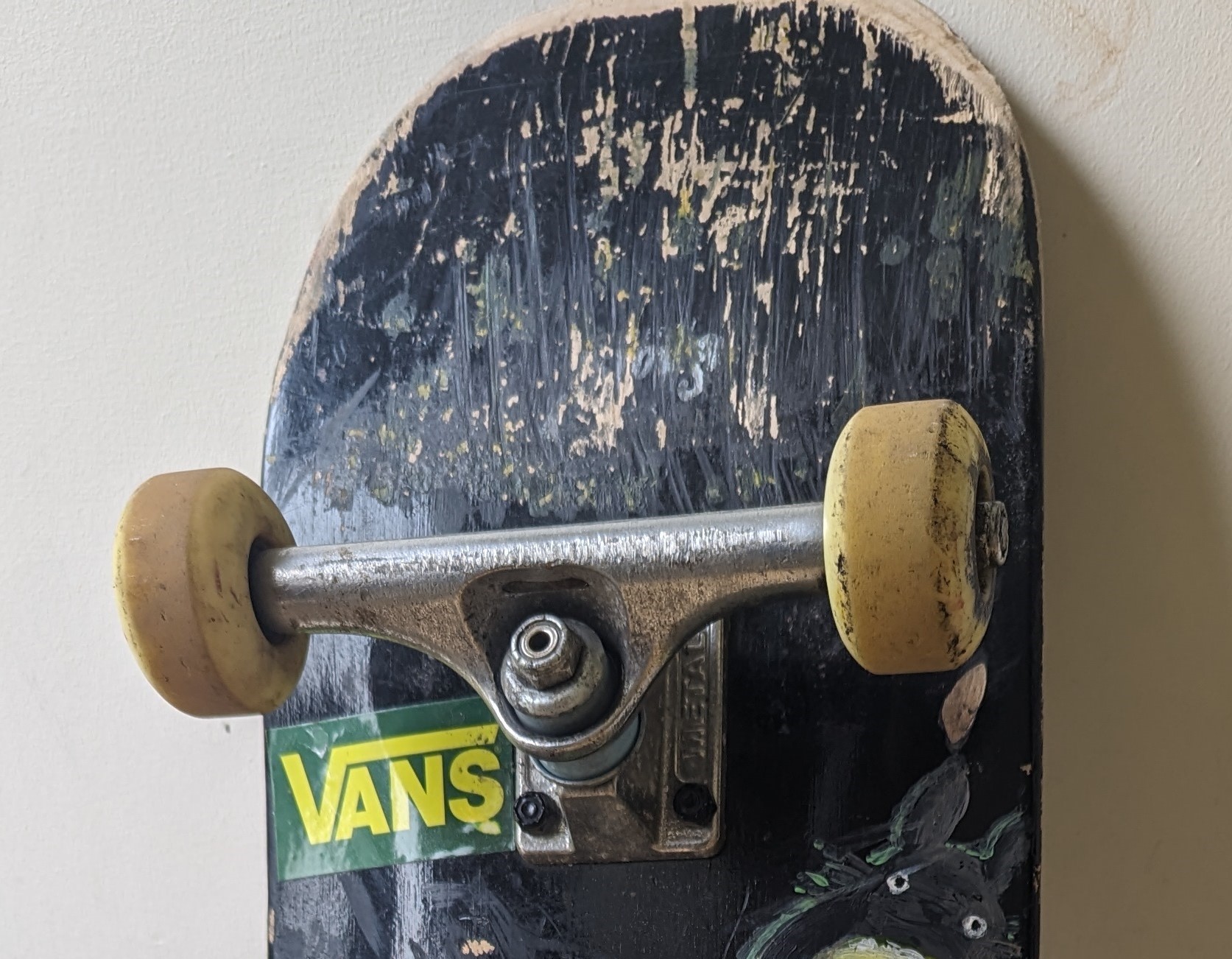

The boneless – named, the story has it, after a puppet – is a silly name for a rather wonderful trick. An underrated one, judging by how rarely I see it done. Which is a shame, because the boneless is a low-tariff trick that also, I think, totally rocks.
The boneless involves grabbing the edge of your board at the toe-end side and then sliding off your front foot, either on a flat, or approaching a step, or (my preference) coming up a ramp or hip. The back foot stays firmly at the very end of the tail, causing the nose to shoot up into the air. Using the front foot as a plant, you then hop into the air, throwing this same foot up and back where it came from, steering the board back down to the ground before landing ‘bolts’ and rolling away – having also, if you’re me, turned yourself and the board ninety degrees (if you’re going over a hip) or nearer a hundred and eighty (if you’re on a ramp).
I’ve described the trick in detail for reasons, I hope, that will become clear. And if this sounds like a lot of stuff to do at once, it is. Which is also why, starting out, I found it so difficult to get my head around.
For a beginner, throwing yourself up into the air high enough to get your feet on the board, in mid-flight, and then not bailing on the landing, is a challenge in itself. Doing this while moving at some speed, which you need in order to get enough height and distance, creates an extra dimension to the challenge; mainly because hopping into the air, on the same foot that a moment ago was still on the board, is weirdly counter-intuitive. It feels like it should involve more stages, but it doesn’t.
Going boneless, as the name doesn’t mean to suggest, can end up very messy.
So where the hell, then, does Zen come into all this?
Stacey Peralta, the former Z-boy turned multi-faceted entrepreneur, once spoke about the unique ‘stillness’ he experienced on a skateboard. Whatever he meant, it sounds like the very opposite of what I’ve just described. But it’s also another counter-intuitive idea. Could there be anything less still than what Peralta, a former professional skater and populariser of the ‘downhill slide’, is talking about?
Not quite. Peralta might well have something else in mind, but in mine at least he speaks to that special feeling of non-exertive motion, one captured by that distinctive image of the skater standing calm and upright on the board as it glides, responding subtly to the shifts in the terrain beneath the wheels. Or maybe, it’s that moment of suspension in hang-time, between the upward motion and the downward fall – a moment when, in a quite literal sense, the skateboarder is weightless.
But Peralta’s notion of stillness hints too at something else, something for me at least much less easy to put into physical terms. Stillness as a kind of silence. Skateboarding, in other words, as a kind of quietude beneath its otherwise noisy, often abrasive surface; the calm centre of a boisterous and teeming world.
I’ve considered the possible mental benefits of skateboarding in terms of how it promotes qualities of ‘mindfulness’ through concentrated practice . This might suggest that skating is a form of meditation, and also a form of Zen – which might sound pretentious, if not for the fact that it skateboarding’s complete lack of pretention sustains this same claim.
The Buddhist scholar Daisetz Suzuki reminds us that the spiritual freedoms Zen promises aren’t to be found via the normal practices of meditation: or not, at least, when this meditation focuses on some sort of higher truth or being. This is because such thinking separates the mind from the body, fixing on something disconnected from what Suzuki calls the ‘concrete affairs of life’. The paradox of Zen, as I see it, is that it attains goals that might well be the same aims of the mediating mind – oneness, freedom, a lightness in the face of the world’s weight – yet it does so in the absence of any intellectual struggle or reasoning directed toward those goals.
‘Upon what do the fowl of the air meditate? Upon what do the fish in the water meditate? They fly; they swim. Is not that enough?’ Suzuki in this way claims for Zen a freedom of the spirit that is the outcome of being purely and singularly present in a given moment. Zen is by consequence something born out of actions, which explains its familiar connection to forms of expressive or martial arts, from flower arranging to calligraphy to swordsmanship. Like the bird in the air or the fish in the water, our life, like any other art form, ‘should be self-forgetting’.
‘How hard, then, and yet how easy it is to understand the truth of Zen!’ says Suzuki. ‘Hard because to understand it is not to understand it; easy because not to understand it is to understand it.’
Not thinking, it should be said, is not the same as switching off your mind. It’s not idleness, either, which (as I’ve already expressed) involves too much thought for my liking. It’s allowing mental processes to become subsumed into complex action, into process. This is pretty much equivalent to the psychological concept of ‘flow’ I’ve discussed before, and the experience of flow through absorbing action could be Zen in so many words (Suzuki, one last time: ‘The idea of Zen is to catch life as it flows’). To find this experience requires work, of course, because achieving flow is dependent upon lots of practice, and increasing degrees of challenge. But a Zen mindset suggests that the secret of the good life is found in these same repetitive acts, which then becomes a discipline.
To some minds this discipline, and the many months or years spent on it, might seem wastefully focused on the smallest of goals: what could be less of a spiritual journey than skateboarding? But the value lies in the great truths learned through this or any other seemingly simple pursuit.
Eugen Herrigel’s superb Zen in the Art of Archery recounts the years he spent under the tutelage of a Japanese master, learning to do nothing more than fire a single arrow into a distant target. Herrigel’s struggle, for most of those years, was to overcome his European belief that the arrow could somehow be made to hit its target with the right technical application. He was right, to an extent, though his true error was a spiritual one: his conviction, in this case, that making the arrow hit the target was the most important aim.
‘The right art,’ the master corrects him, ‘is purposeless, aimless!’ The perfect shot is not something that can be made to happen: rather, it happens ‘when the tension is fulfilled’, and when the shot ‘must fall from the archer like snow from a bamboo leaf, before he even thinks it.’
Zen in the Art of Archery is rightly seen as one of the first great books about sports psychology, because it recognises that application to a task results in that task happening almost involuntarily and unconsciously – which is also to recognise not only that some athletes, including skateboarders, are Zen masters without knowing it. It also recognises that sport can itself be deeply spiritual, at the point when things happen not as the outcome of force, but instead – ‘like snow from a bamboo leaf’ – as something seemingly natural and effortless.
Herrigel’s teacher bamboozles him with his notion that there is no ‘I’ that shoots the arrow: rather, ‘It’ shoots. This sounds like mysticism, but it’s actually grounded in science. Top-flight footballers or tennis players are constantly adjusting and improvising, with great skill, at great speeds; while elite gymnasts, like skateboarders, execute fiercely complex manoeuvres without having the time to ‘think’ about them. This is because, via hundreds and then thousands of hours of application, the mind no longer needs to tell the body what to do, and the two arrive at a point when their actions are effectively synchronised and automated. The opposite of this – when an athlete is thinking too much about what they’re doing – is what it actually means to ‘choke’.
There are many reasons why landing any skate trick brings with it a deep sense of satisfaction, but I’ve come to realise that at some level, it’s not so much the brute fact of having ‘done’ the trick: rather, it’s that sense of thoughtless perfection and effortless grace – that feeling of lightness and clarity the Zen practitioner calls satori – that comes upon you when everything simply clicks.
The good news is that, unlike Herrigel, you don’t need to train for many years to find this: with the right attitude and application, and a decent level of practice, it can happen to anyone.
For months, I struggled and failed to land the ‘shove-it’: a pretty basic trick that involves jumping from the board in a scissored kick, spinning it 180 degrees below you and landing back on the deck in the original stance. In this case, to say I struggled and failed during this time would be right on the mark. Every attempt felt like forcing and straining my mind and limbs to do something that wasn’t happening, that for much of the time wasn’t even close: until, that is, after more weeks of trying, and of making subtle, possibly unconscious adjustments to my stance and leap, I finally landed it. Or to be more accurate, it landed itself, and I became no more than the vehicle for the mind and body’s harmony. As if, in a way, I had done nothing at all.
Which brings me, finally, back to the boneless.
The challenge of the boneless, as I described above, is one of coordination. But its also, in turn, one of forgetting. Think too much about what you’re trying to do, and the pieces will come unstuck. You’ll see yourself working it out, one stage at a time, by which point – since the trick itself lasts just a second – it’s already too late, and the moment has gone.
When it works, on the other hand, everything just kind of comes together in one swift and fluid movement, like snow falling off a leaf. Which, for a moment, you become, feeling that precious moment of hang-time, a brief flash of weightlessness – stillness – before you crack back down on the ramp.
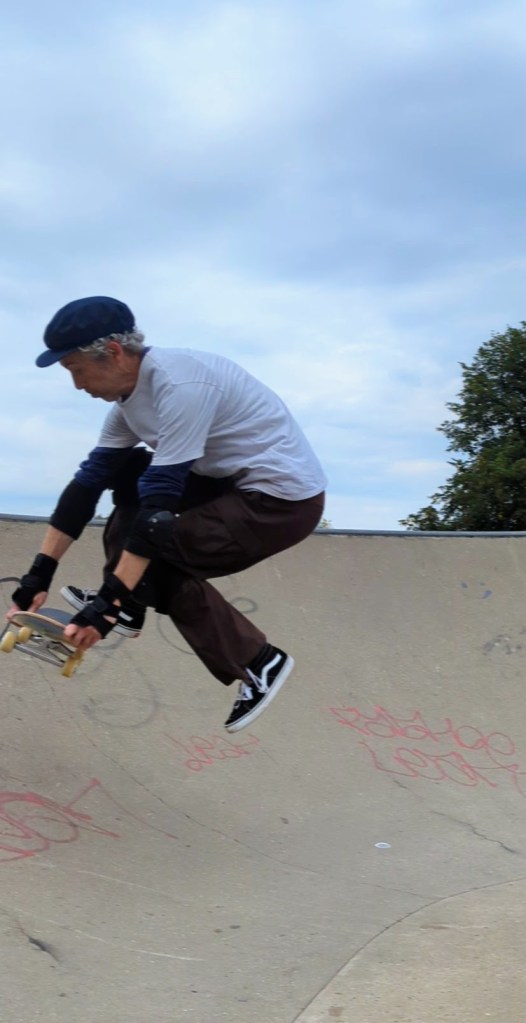
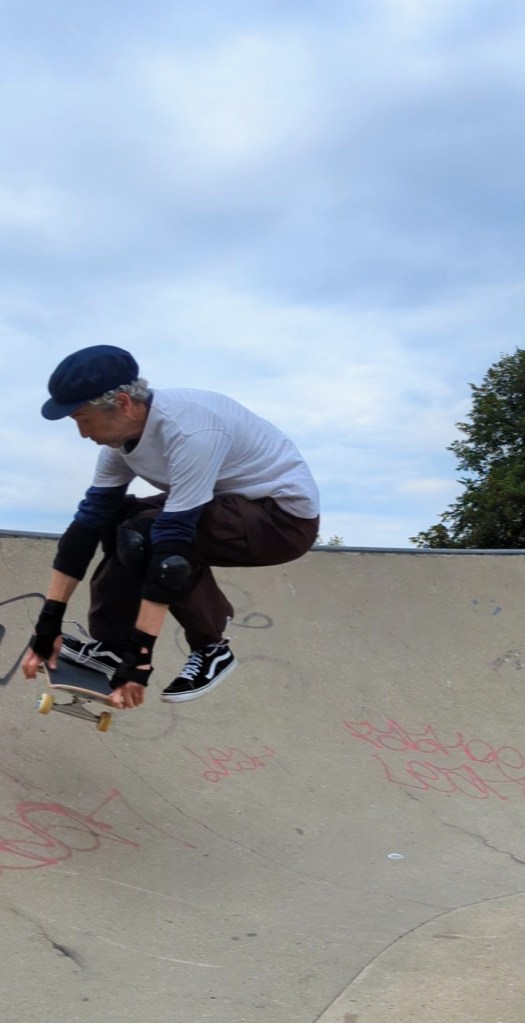
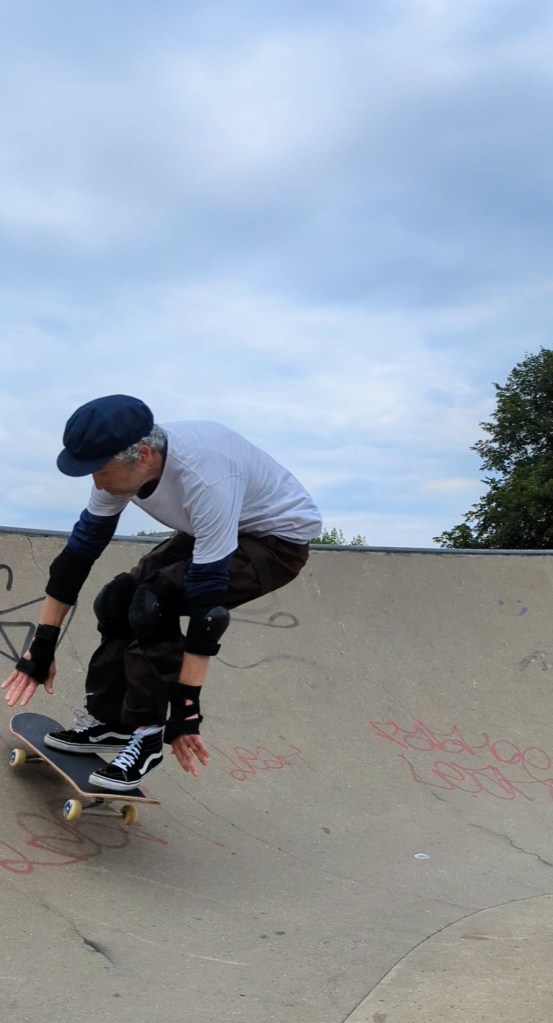
Coming together like this, the long and intricate combination of moves, as with any trick pulled off, attains a haiku-like simplicity:
The scrape of cement
before air – silence – and then
the slap! of the wheels
followed by the quiet amazement at having landed and still being on the board, continuing on as if nothing really happened.
Something has, of course, though if I’m honest, I only played a small role. You can’t be that amazed at your own prowess, since you weren’t even really thinking about it, which means ‘you’ didn’t really ‘do’ it at all. The true amazement is at the fact that all those things can happen at once, through you, so perfectly; which is also to witness to a deeper philosophical truth, both about yourself, and also about the world.
 More Than Coping
Leave a comment