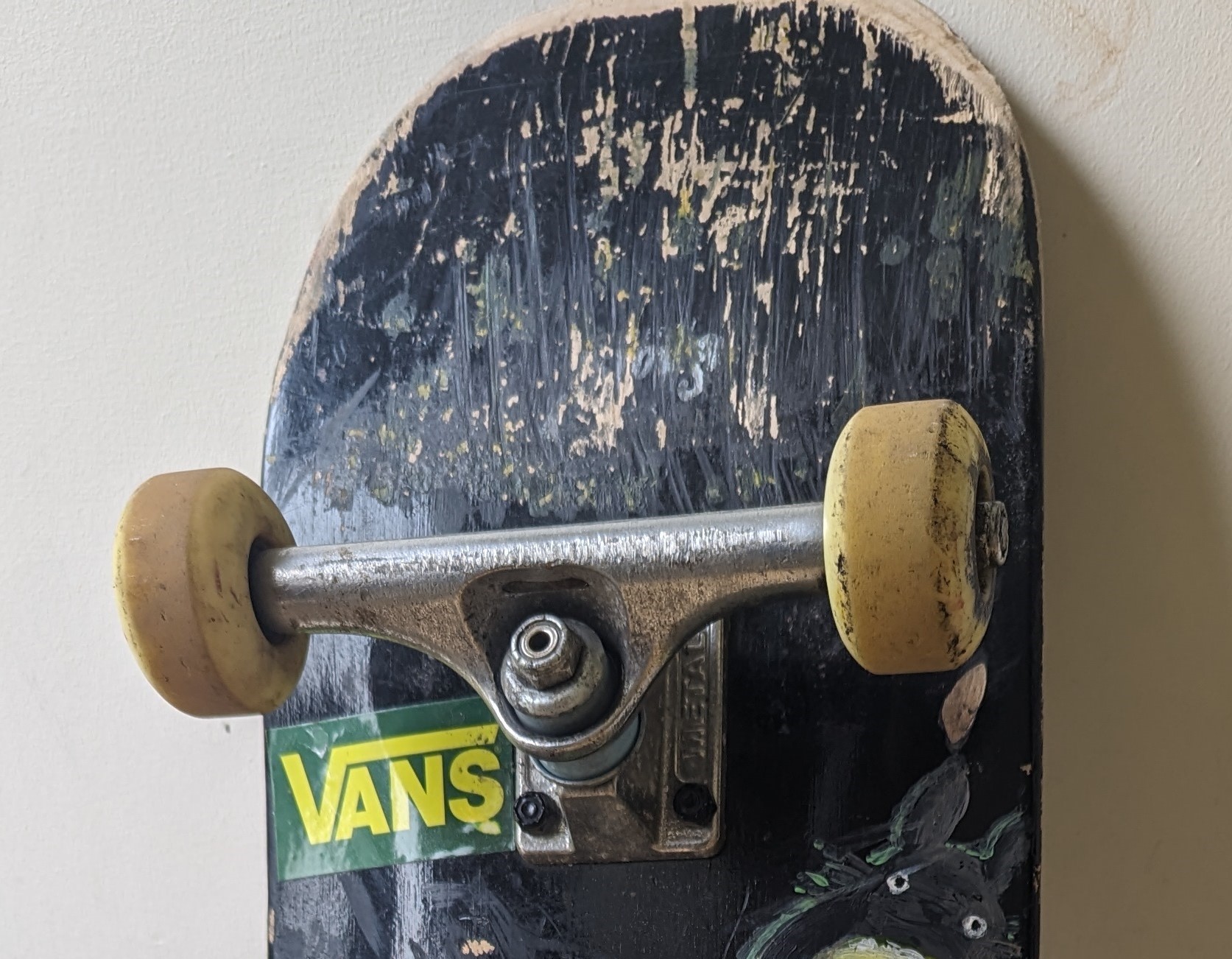
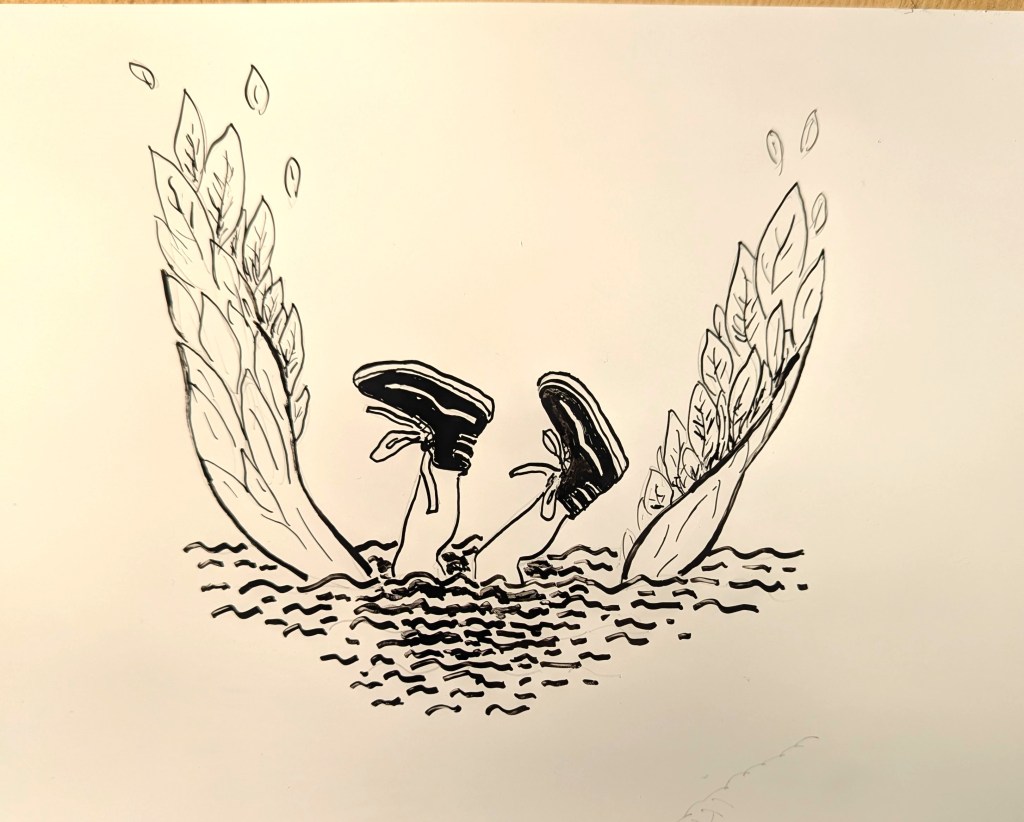
Among my various skating daydreams, I’d allowed myself to imagine that whatever milestones I hit, they might be met with an equally significant reaction from those around me. That my successes, in other words, would be duly celebrated.
I know now that this was a bit naïve. But it wasn’t an unfounded hope.
As a newbie just starting out, I’d soon learned and also picked up that distinctive skater habit of hitting the tail of the board on the floor, either to acknowledge someone’s successful trick, or more frequently, to encourage them in failure. Appropriately enough, I’d been on the end of this particular treatment myself a few times, typically when I found myself on the floor rather than still on the board.
This acknowledgement didn’t have to come from someone I knew. Most often, it was from a stranger – which, given my unusual position in the skate park, was almost anyone. This made the gesture even more welcome, an honest sign of support and recognition across generational and social divides. I quickly got used to returning the favour.
Maybe it was just being part, as I saw it, of this silently acknowledged community of skateboarding, added to the way certain goals had taken on an almost mythical image in my mind, that I blew up my expectations. A few months in, I’d come to imagine all kinds of Hollywood scenarios meeting my essentially mundane – though, to me, extraordinary – achievements. As I described a while back in this blog, such was the combined frustration and anticipation I’d built up around the holy grail of dropping-in, that I envisaged my first time soundtracked to a raucous chorus of board-tails and cheers, greeting me as I sailed towards waiting skaters on the opposite ramp, my arms aloft in triumph.
As it happens, I have a short reverse-angle video of me dropping in, that same day in 2023, for what was probably the third time or so. It took place a few minutes after my first success, though the reaction, I recall, is the same as it was for my first fully-realised drop. It’s one, of course, of utter indifference; of other skaters idly kick-turning or tick-tacking as they ponder their next moves. The only soundtrack, rather than the clattering of board-tails, is that of my own wheels clattering onto the ramp and then fading as I roll off into the middle distance. The same song, unchanged and unmoved, plays undramatically on the park’s sound system. I reach the fabled opposite ramp and then, without momentum to get up, and unsure what else to do, I simply stop and step off.
No one notices. No one cheers. They’re all, perfectly reasonably, doing their own thing.
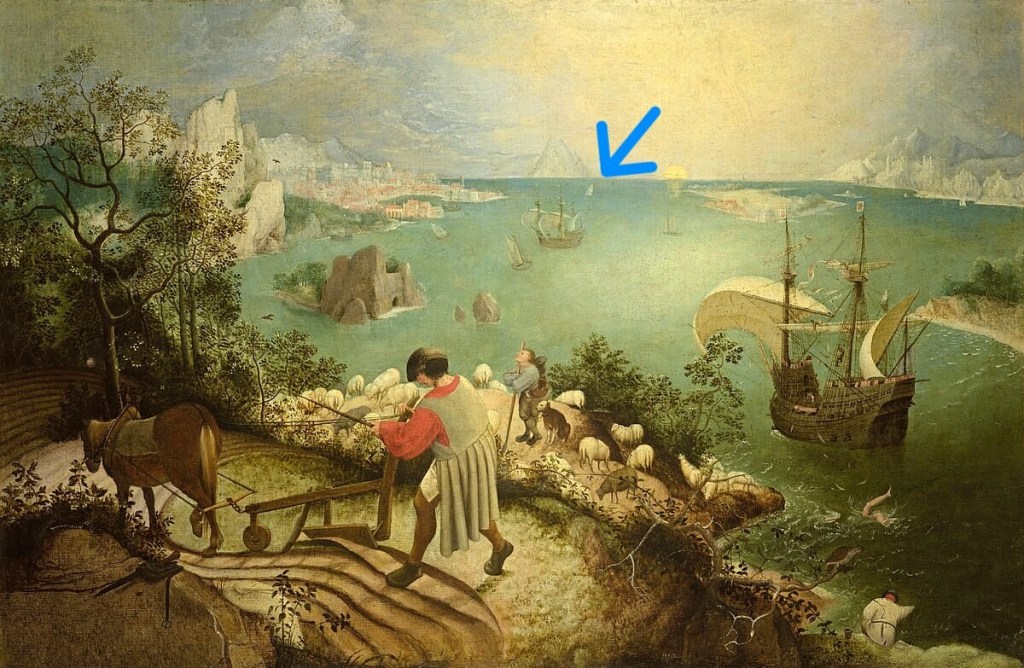
I was surprised when, watching this video again the other day, it dislodged the memory of a poem: W.H. Auden’s ‘Musée des Beaux-Arts’, verses I’d more or less forgotten until this point. Auden is describing ‘Landscape with the Fall of Icarus’, a sixteenth century painting hanging in Brussels. What captures his attention is the way the painting’s main event – a boy with mechanical wings tumbling out of the sun, and into the ocean – is not up front, but is a mere background detail obscured by everyone else’s daily business:
In Breughel’s Icarus… everything turns away
Quite leisurely from the disaster; the ploughman may
Have heard the splash, the forsaken cry,
But for him it was not an important failure; the sun shone
As it had to on the white legs disappearing into the green
Water, and the expensive delicate ship that must have seen
Something amazing, a boy falling out of the sky,
Had somewhere to get to and sailed calmly on.
It’s clearly both a popular painting and theme, since the American William Carlos Williams gave it a similar treatment, in a poem named after the painting itself:
According to Brueghel
when Icarus fell
it was spring
a farmer was ploughing
his field
the whole pageantry
of the year was
awake tingling
with itself
sweating in the sun
that melted
the wings’ wax
unsignificantly
off the coast
there was
a splash quite unnoticed
this was
Icarus drowning
You can take what you want from these lines: a reflection on nature’s lack of concern for our actions, or on the hubris of trying to become divine: whatever you will. Where I now re-read these poems, though, is not in their dwelling on Icarus’s failure, but in their lack of concern for the success or otherwise of his flight.
Tucked somewhere inside Auden’s poem is the romantic Icarus, the boy who flew too close to the sun. For Icarus – at least until his waxy wings turned to mush – this effort, even if it ended in disaster, was ‘important’. From one perspective, the poetry of the whole thing turns on the fact of failure: the unnoticed little ‘splash’ that is the only visible record of Icarus’s flight. But what if we flip this slightly? As Auden notes, this failure still produced ‘something amazing, a boy falling out of the sky’ – and yet for all that, the nearby ship ‘sailed calmly on’. Even human flight, these poems suggest, might be something ‘unsignificant’ in the broader picture.
This sounds pessimistic, even a little grouchy by today’s standards, when it seems almost nothing is unsignificant, and when all this nothing needs to be relentlessly witnessed, recorded and re-watched. But there’s a solace here too: call it a sense of greater perspective, an awareness of far more permanent things than our particular individual struggles and vanities (or our social media posts).
Yet even in the realms of achieving success, too, it’s perhaps strengthening not to have to be concerned with the recognition of others, anonymous or otherwise: that ‘prison’, according to Lao Tzu, that is the pursuit of other people’s approval. This idea of doing something simply for its own sake is, in these broadcast-yourself days, an unusually ascetic one. But like any art form, or performance, or athletic goal, skateboarding is a deeply ascetic practice at heart, demanding a commitment to repetition, pain and repeated failure that is only for the most determined of acolytes. And just like writing – like writing this post, in fact – doing it for the recognition of others is neither guaranteed nor, I would say, the true aim. The real target, like the archer’s trying to find Zen, is never a visible one. And if it is, it’s just Insta-bragging.
And that’s just the tourists. It’s one of the many downsides of mediated competition that chest-thumping, finger-pointing celebrations – for the goal scored, the race won, the putt made – have become such an expected feature of world sports. Which is perhaps why, among the many reasons there are to like skateboarding’s parent sport of surfing, we should respect not only its intrinsic solitude, but its wider resistance to what surfers call ‘claiming’ a wave. As William Finnegan writes in Barbarian Days: ‘The best thing to do by far, if you came flying out of a deep tube was nothing. Keep surfing. Act as if such things happened to you all the time.’
As Finnegan adds, in the contexts of such a wild ride this is far from easy. Yet in place of ‘an obnoxious fist pump, or arms thrown-up touchdown style’, he allows ‘some acknowledgement that something rare and deeply thrilling has just happened.’ This might sound like studied cool, no more than a different kind of pose. But there’s a sense of humility here, too: a recognition that, in the grander scheme of things, the wave will always be bigger than you; or that, in catching it, there’s perhaps as much a hint of fortune, a sense of the elements combining in your favour, than there is personal skill.
Not long ago I was attempting a pretty basic sort of 50-50 grind; nothing special, really, but a whole new world to me, used as I am to moving forward with four wheels strictly on the ground. The trick involved dropping in and then rolling up a small ramp, linked to a long box with a coping edge I traversed on my trucks, leaving only the backside wheels in slight contact with solid wood. My aim was to maintain this shape the whole length of the box, and then that of the ramp at the other side, from which, all being well, I would roll serenely away.
In the course of trying, I’d come pretty close on a couple of occasions, and on another, spectacularly un-close. For reasons that, not unlike the board itself, I couldn’t quite pin down, the wheels jack-knifed beneath me on the exit ramp, sending me sliding face-first onto the concrete; my legs, though neither white nor disappearing, nevertheless up in the air: like Icarus, this time, in an inverted parody of flight.
No one really seemed to notice, or if they did, it merited little attention. This, after all, was what skaters did, especially kooks like me, and besides, they all had somewhere else to get to. Which is also why, not long after, no one seemed to notice when I held my shape to the final inch of the ramp, keeping my trucks parallel to the edge, then skated off and onwards in a nothing-special kind of way.
It wasn’t a failure this time, not even an important one; yet that didn’t make it an important success either – at least not in the broader picture. But since success in skateboarding is measured only by the goals you set for yourself, none of that mattered. I allowed myself a discretely clenched fist, a muttered Yes, and quietly got on with something else.
Because after all, no one wants to tempt the skating Gods.
 More Than Coping
Leave a comment