As I now understand it, the old chestnut that we only use ten per-cent of our brain is total crap. About the rest of the body, though, I’m not so sure.
This much I do know: I couldn’t name even five per-cent of my body’s bones or muscles. Even if I could, I probably wouldn’t know where most of them were, for the simple reason that I haven’t felt them at work. The truth is that for most of my life, my own body – not just its internal organs, but its skeleton, muscles and skin – has been a complete stranger to me.
To be clear, that’s not for any lack of physical activity. I’ve been a runner since I was a child, for one thing. By my early fifties, around the same time I started skating, I was running practically every day. But I’m not sure this wasn’t actually part of the same problem.
For some time prior to taking up skateboarding, I’d started to become increasingly aware of this limited physical awareness on my part, but because, rather in spite of my efforts to put miles on my running shoes. I’d become, in effect, little more than a machine for running; the extent of my bodily potential limited to that that punchy swing of the arms and plodding pounding of the legs. And when I wasn’t a machine for running, or at least walking, I was no more than a machine for sitting, be it at my desk for writing, at my table for lunch and dinner, or on my couch for pretty much everything else.
Welcome, I thought, to the rest of my life!
After my injury last year I spent a good month or so back on that same couch, though by this point, it’s fair to say my relationship to my body had changed considerably. Breaking an ankle is a weird combination of circumstances. Not being able to move it much, you’re always aware of this absence, and when you do move it, you can feel every creak and crinkle it makes. This means that you become much more attentive to that slender but hugely weight-bearing joint than you probably ever were before. Put that together with the physiotherapy I was fortunate enough to have (thank you, NHS!), and it’s like being slowly reacquainted with a friend you forgot you had.
In a way that’s a neat analogy for physio itself. When I started, all I expected was that it might slowly get me back to how I was before. But it’s a lot more than that. Really, it’s a way to find out what your body actually does – if only you’d known it in the first place.
Part of my early physio involved revolving my foot over and inwards, in such a way that the curled sole is turned up towards you (perversely, it’s a bit like turning your ankle joint to the kind of angle it would be if you sprained it). I found (and still find) this very tricky to do, but not because of any restrictions caused by my injury. It was simply a way of moving my ankle that had never occurred to me before, at least not consciously, or without involving some terrible pain.
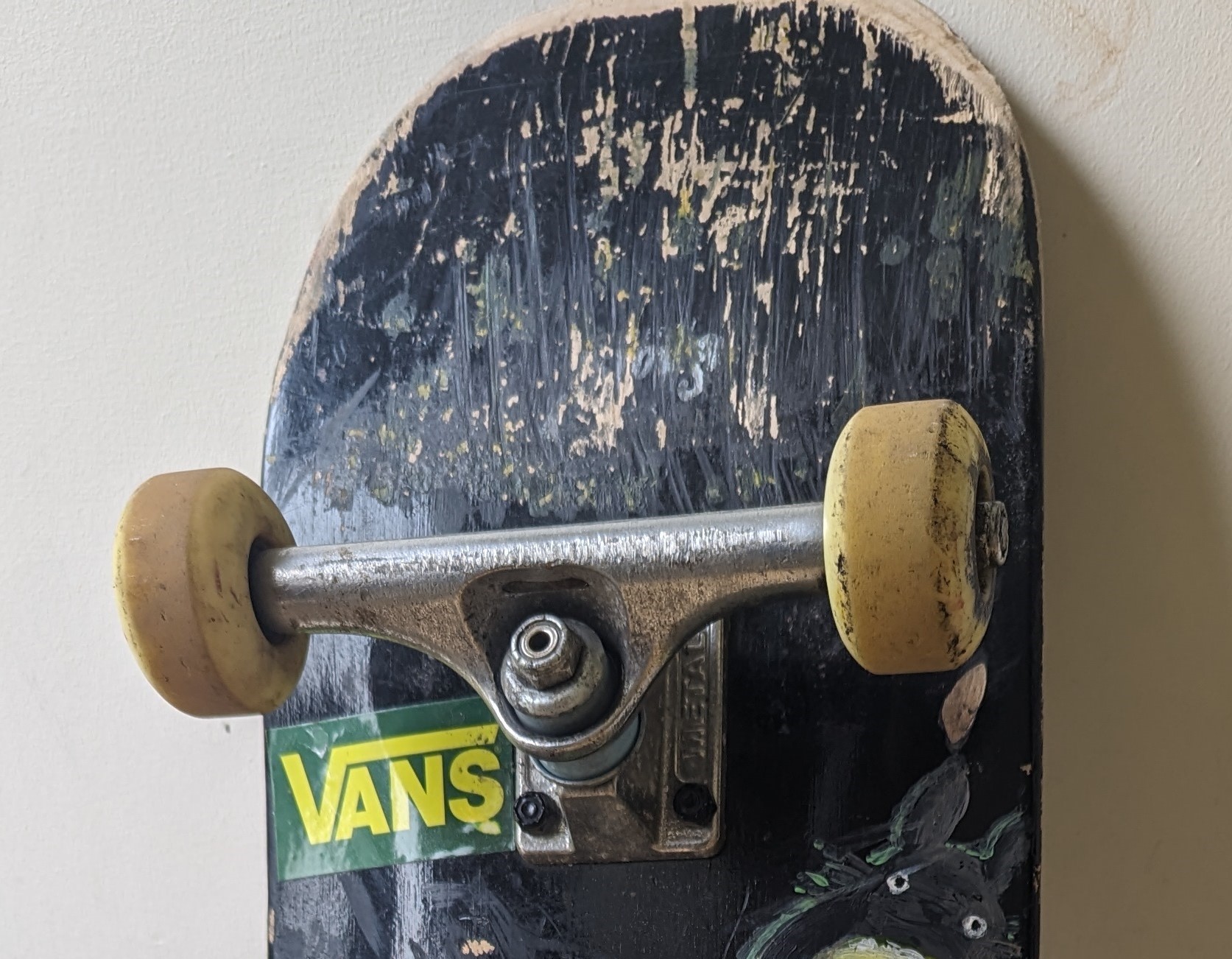
Until, that is, I was reminded of where I’d moved this way before. It was at the skate park, only a couple of months before, where someone was giving me tips on improving my ollies. The problem, he told me, was that I wasn’t getting my front foot either square enough or rotated enough to give the front of my board the necessary forward kick (and hence, I was hardly lifting off the ground). Following his example, I turned my foot over and inwards, the sole of my shoe now facing its twin at the rear of the board as much as the grip-tape beneath it. It felt unnatural, like I was wringing my ankle into a position it had no normal right to be. But as far as my admittedly still meagre ollies were concerned, it worked.
I’d taught my body to do something it hadn’t done before, which is to say, in short, that skateboarding is itself a kind of physiotherapy. And as any therapist will tell you, the work never really ends.
In a way, I’d probably known this much already. Learning to skate had turned out to be a refreshing wake-up call for my regimented body, bored through habit. For weeks and then months, no trip to the park came without some sort of lingering but strangely satisfying agony. Aching calves; sore, swollen wrists or fingers; the throb of a battered shin or tired glutes; shoulders aching and raw, like pulled pork might feel if it had a brain. These were all immediate signs, of course, that the body was in need of repair; but this was prompted here not by injury, but by the fact of the body doing something entirely new, and therefore disrupting its previously steady state.
Everything new aches somewhere, I’d learned, which is why I happily embraced these pains for what they meant, which was that my body was subtly rebuilding and reorienting itself. Sort of like growing pains, but all over again. At fifty-two.
Or as I most clearly experienced it: a process of finding your feet.
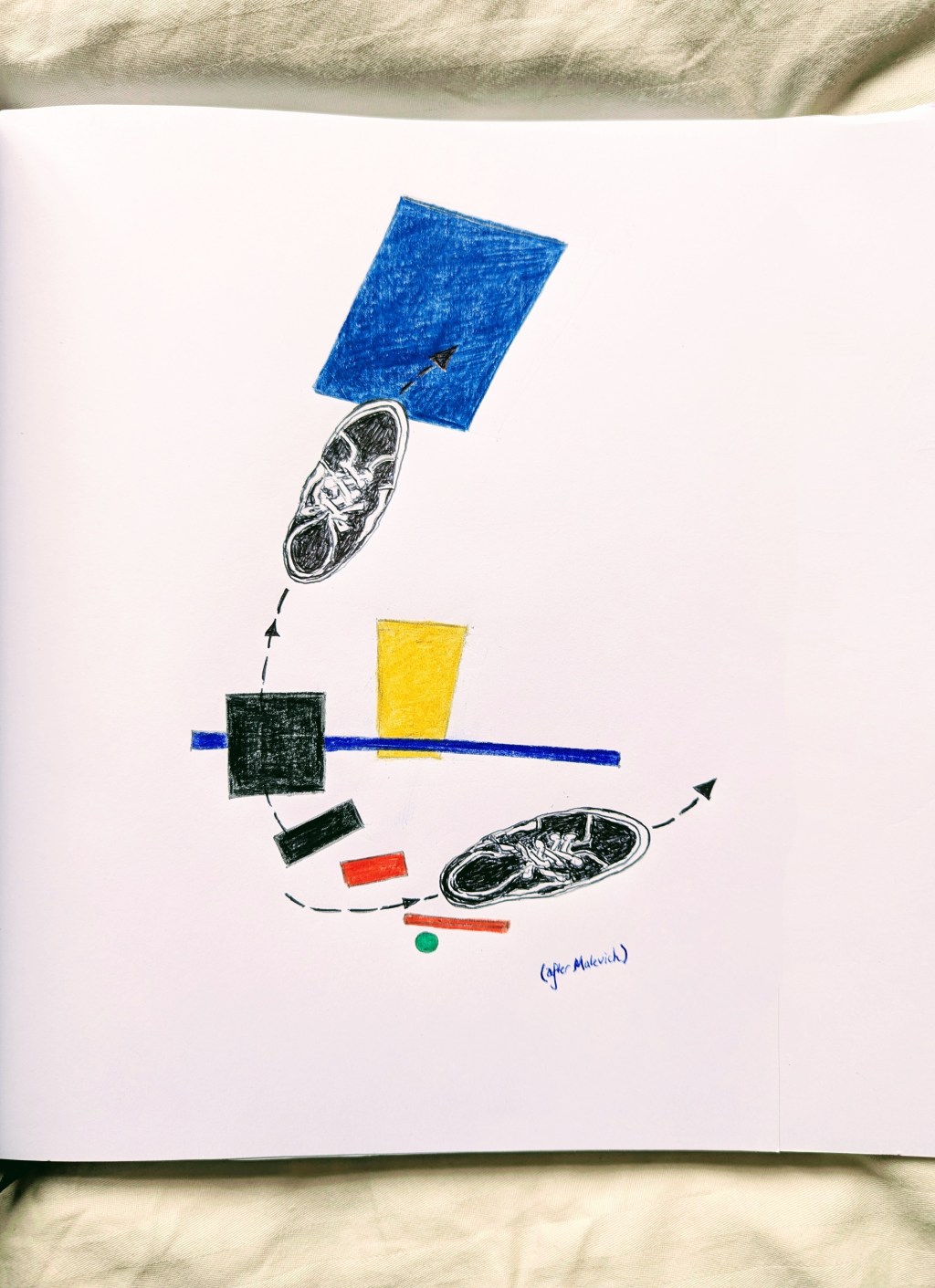
I think it was probably on my second visit to the skatepark that I met a fellow mid-life learner who already had a few months under his belt. The topside of his board, I noticed, was sketched with various chalk-white lines, alternately parallel, diagonal or curved, which together made geometric patterns across the deck. Given the expressive relationship skaters have to their boards, for all I knew this was his homage to Russian Suprematist painting, but it turned out that these lines were visual directions for his quite sizeable feet: where to place them for this, where to move them to for that. A graphic map for the heels and toes.
Such an approach struck me at first as being overly technical and pedantic, even to the point of joylessness. Or at least it did, until I discovered there is little joy in falling over all the time. Such precision is important in a sport where – to take the basic example of dropping-in – you are essentially allowing yourself to fall down an incline, balanced only on a two-and-a-half foot sliver of wood on wheels, and still be standing on it seconds later. Precision is vital too when you want to make the same bit of wood twist or flip or spin, and sometimes all three at once in the space of a second, and land again without falling off. Think of the baffling combinations of button– and trigger-pressing needed to complete moves in most video games, where you have the use of at least two thumbs and two more fingers. Now apply that same principle to your ungainly plates of meat.
Take what is, in truth, one of the most basic and therefore most attainable of street tricks, the ‘shove-it’; so called because it requires you to push the board away with both feet in a kind of simultaneous scissor motion, sending it spinning a flattish 180 degrees (or 360, if you’re really good), then to bring your jumping feet back to land on the deck, preferably in perfect balance over the wheels (or ‘bolts’). Simple enough, in its way, though even this fairly easy move, when done in motion, involves a catalogue of precise placements and adjustments. It goes something like this; though in the heat of the moment, to use a phrase, this all goes without saying:
Push off slowly, front foot diagonal across front screws, bring back foot to tail; wriggle front foot to a spot mid-way down the board and slightly back towards the heel-edge, keeping it diagonal, while simultaneously shuffling rear foot towards the toe-edge of the tail. Kick front foot forward while flicking rear foot backward and jump. Wait for spin. Land, ideally across front and rear screws. Keep rolling.
Learning to do this trick (it took longer than I’d hoped) was something that only happened partly in the head, seeing as the more I thought about it, the further away from it I seemed to get. It’s more accurate to say then that mastery of this trick was something that happened in the feet themselves. And because, through both this trick and others, they were now doing things I’d never prepared them for, I became weirdly aware of my feet in an entirely new way. Feet that, at rest, would once merely flop around uselessly and heavily, little more than fish-shaped flaps, would now be traversing those imaginary geometric lines in the air; sketching out a Malevich canvas in space, rehearsing for a performance in which they would be the main actors.
I’d learned, in fact, to articulate with my feet.
For Leonardo da Vinci, the human foot was both ‘a masterpiece of engineering and a work of art’; a claim that, until I put my own feet to the test on top of a skateboard, was one I grasped more in principle than practice. Funnily enough, my initial thought at the time was not that I’d become some sort of Renaissance vision. I confess, in fact, to feeling more like a chimp, armed now (if that’s the right word) with a second pair of hands at the end of my legs. And that’s just fine. Because once that happens to you, you may never see your body in the same way again – precisely because your body is so much more now than it was before.
 More Than Coping
Leave a comment