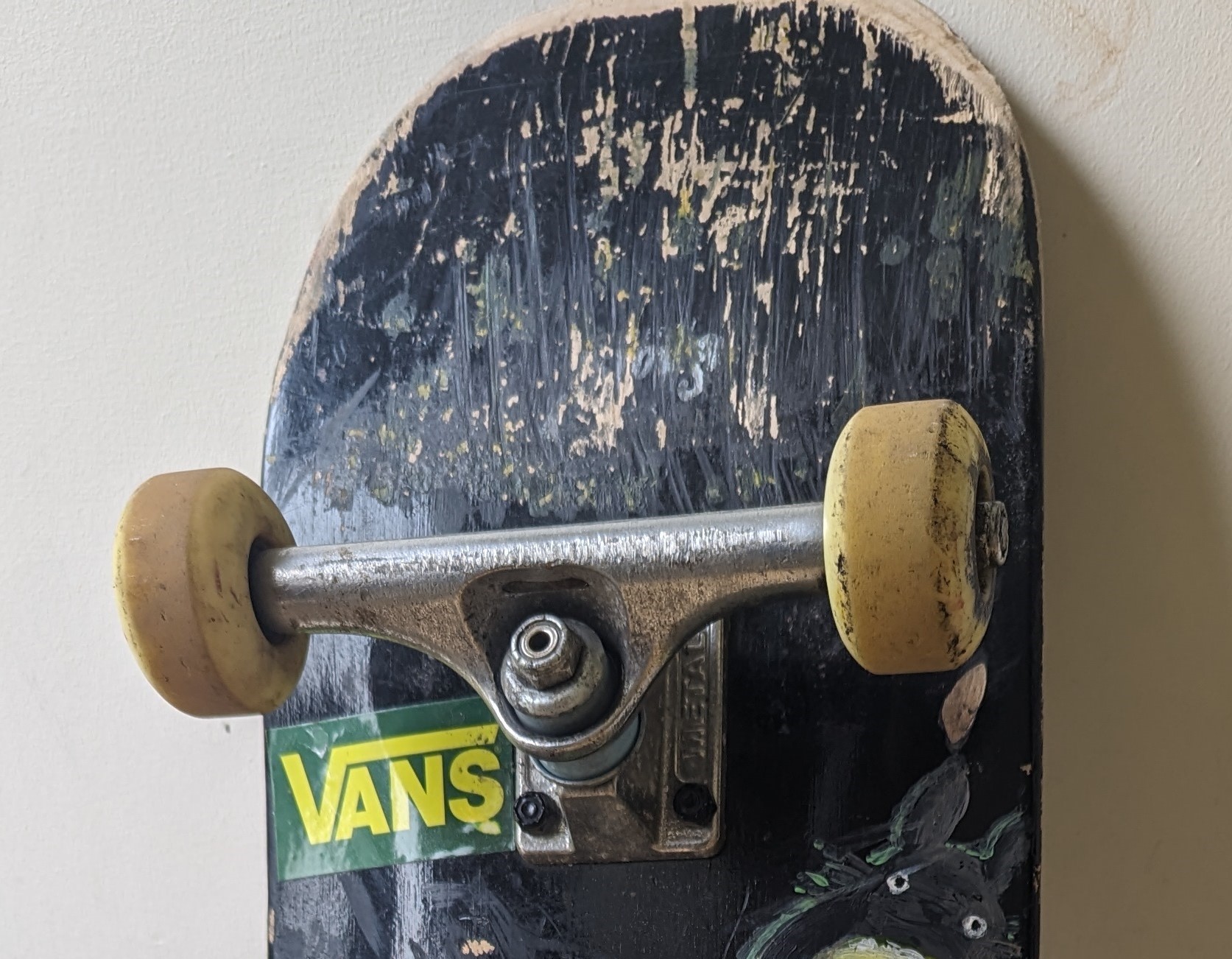
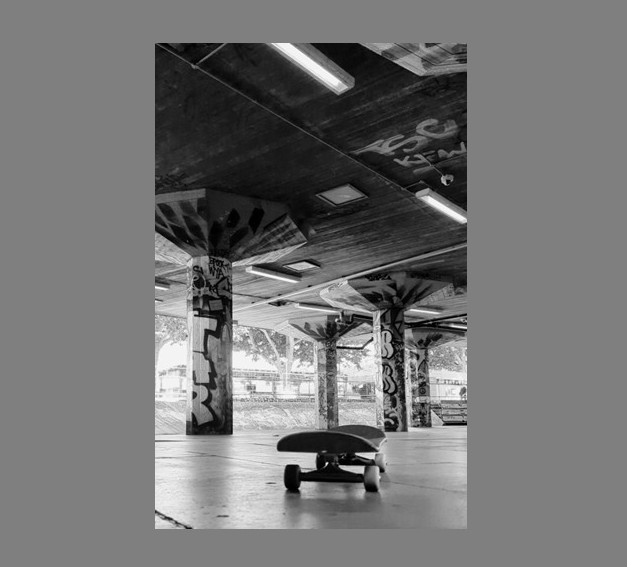
If skateparks were made in heaven, they might look something like the Undercroft.
Nestled between the Royal Festival Hall and the National Theatre on London’s Southbank, the Undercroft offers three levels of smoothly paved flats. These are separated on one side by a short, sloped ramp, and on the other by a steeper incline and seven-stair set, this deepest section bordered by two inclined, five-foot banks. The Thames runs no more than fifty feet away, with views west towards the Palace of Westminster, and to the east, Waterloo Bridge and the dome of Saint Paul’s.
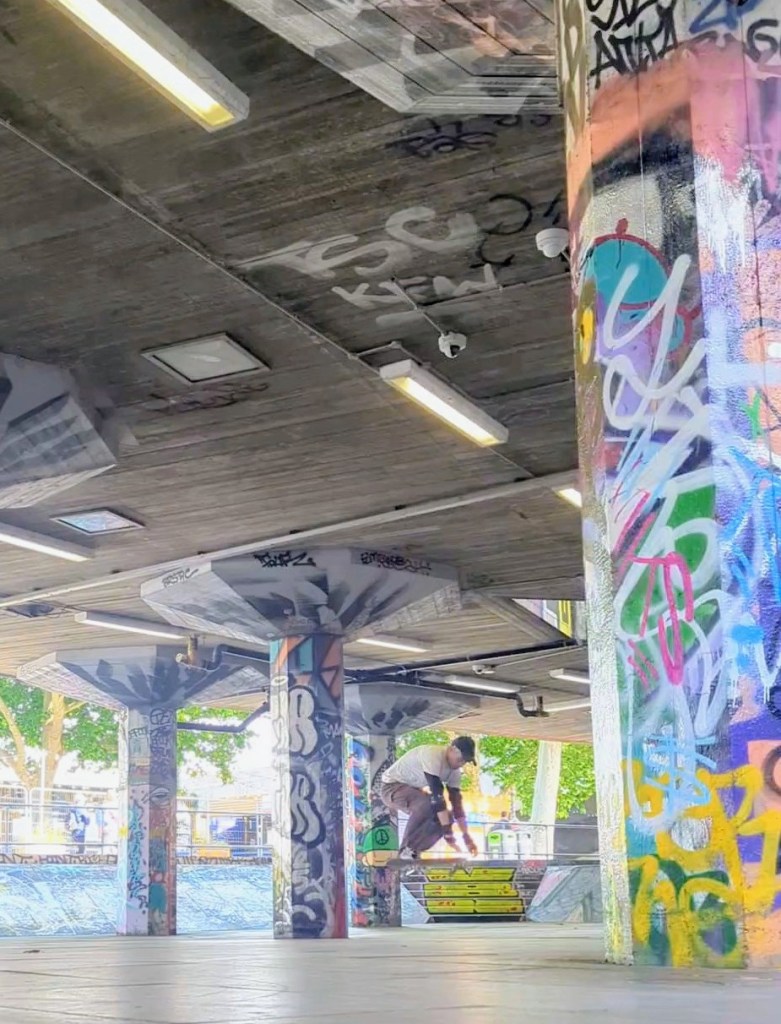
The June morning I’ve come here to skate it’s drizzling, hardly a rarity in the British capital. But since the Undercroft is covered by the concrete mass of the Southbank Centre, with strip lighting across its high ceiling, down here it’s always sunny.
As with many skateparks made in heaven, it wasn’t built as one at all. Aside from the slabs and sole quarter-pipe added to the site over recent years, none of this was built for skaters, but merely as a non-specific pedestrian space by experimental (and clearly forward-thinking) 1960s architects. I’m also here to see an exhibition, Skate 50, celebrating the five decades since skaters made the Undercroft a centre for the burgeoning London skate scene: a label that has stuck, despite resistance from London councils since the late 1970s, and even plans to reconvert it in the 2010s.
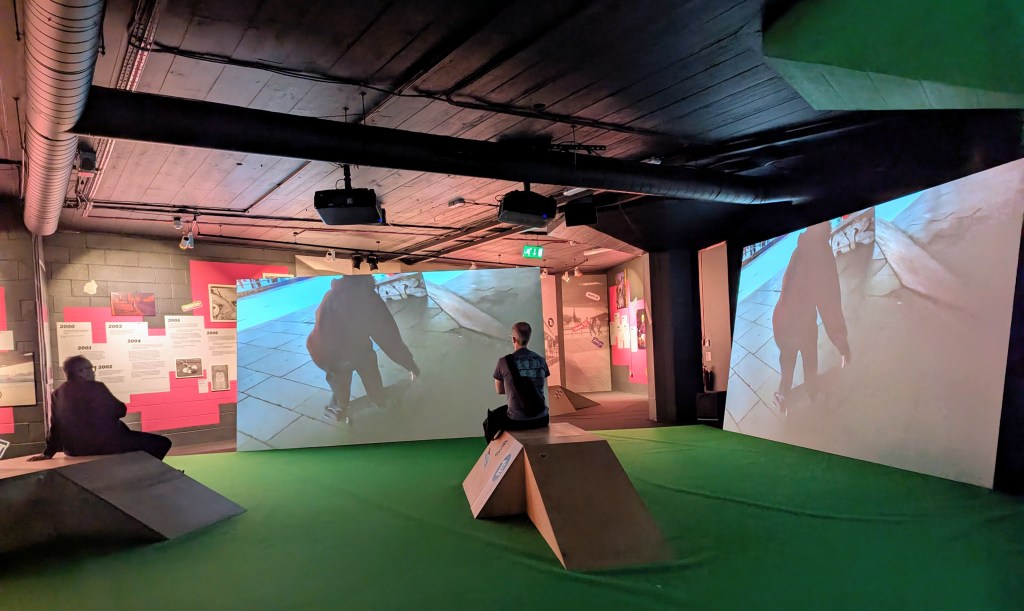
This is of course part of the Undercroft’s magic: its origins as an appropriated space, one shaped by the improvisation, and the imagination, of its users; an idea central to skating history and evolution. What we came to call skatepark design was, it’s worth remembering, largely influenced by the shape of swimming pools whose emptied bowls proved so appealing and inspiring to dry-land surfers in the mid-1970s. Likewise, back in the 1970s, the flat gradients around the Undercroft didn’t look like anything in a skatepark, because in the UK at least they barely existed. Yet what they resembled, uncannily, was the sloped and skated banks found in Californian public school yards and dried-out spillways.
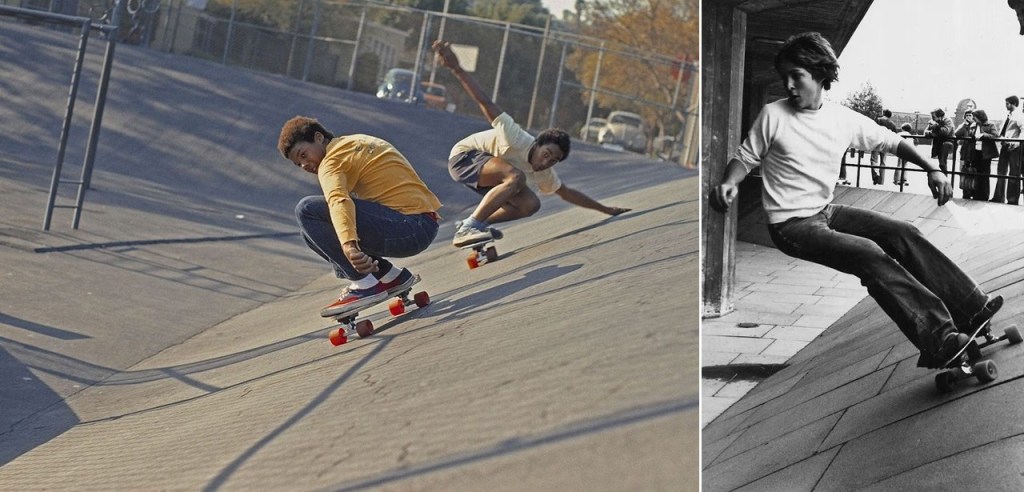
Photographs by Glen E. Friedman (left) and Stéphane Decool (right)
Like these formative locations of world skating, the Undercroft wasn’t a space that told you how and where to skate: it was, in essence, a place invented by skaters. And it in turn goes without saying that, in a city that sometimes feels like a machine to extract money, entry to the Undercroft is also absolutely free.
All the same, until not long ago, I felt that the Undercroft exacted a kind of price on its would-be users. This recent visit – as a skater – was my first since almost three years ago, at which time I ventured there as an almost complete beginner. Prior to that, my contact with the Undercroft had been on occasional visits to see family, passing by on walks along the river. It was on one of these same visits that I signed the petition to preserve it as a place for skaters, though my interest at that point was strictly that of a viewer, not as a future participant.
In a way, the Undercroft reinforced that binary between the watchers and the watched; or at least the metal barrier did, placed by the council along the perimeter, and in turn segregating the skating area from the riverside walkway. With the ambiguity so often built into modern urban architecture, this fence gave semi-official approval to the designated area, while at the same time ensuring that this same area remained contained beneath its concrete roof. Yet the other, possibly unintentional effect of this barrier was to frame the Undercroft as one further piece of performance space along Southbank’s already culture-rich riverside. What might once have been an area you or other tourists had to either negotiate or perhaps just avoid, was now somewhere you could safely stop and watch.
Which meant that, as a skater there, you unavoidably became part of a spectacle.
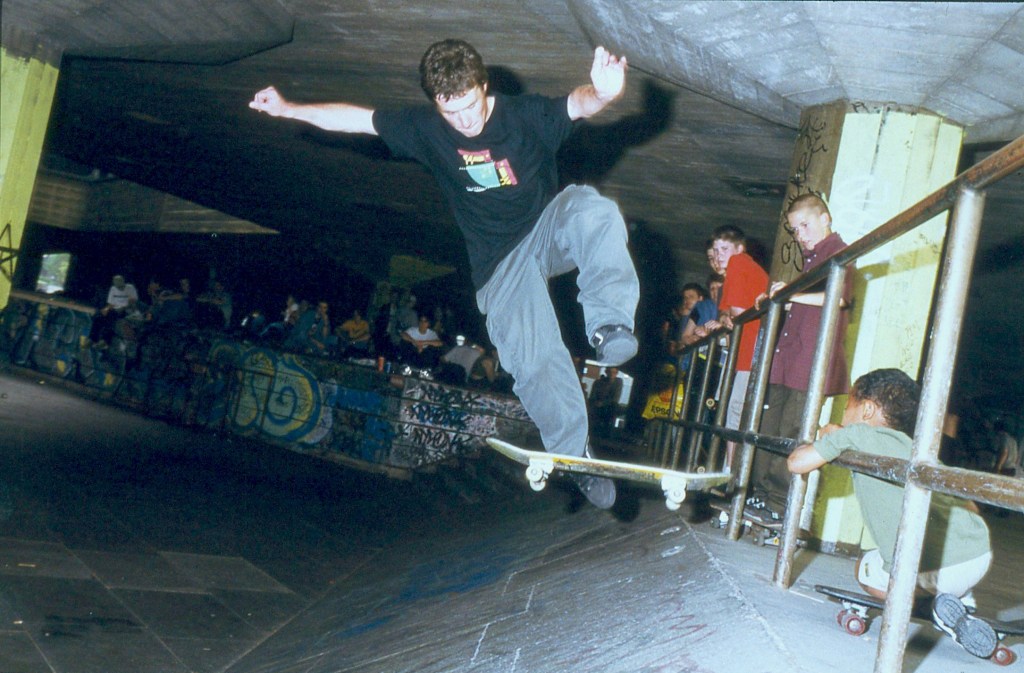
Photograph by Brian O’Halloran
That first visit in the summer of 2023 had been an impulsive one. On this occasion my daughter and I had been in town for a week. We’d run out of puff at the small bowl in our ‘local’ Bishop’s Park, further down the river in Fulham. But the sun was shining and the day was still young. Putney Bridge station, with a direct line to Southbank, was five minutes away. The thought suddenly hit me. Why not go to the Undercroft?
Why not, indeed. And yet, walking over Hungerford Bridge a half-hour later, my board pressed self-consciously between my arm and right hip, I was less certain. The nearer I got to the Undercroft itself, the more I hesitated. Should I really go in? Was it really that easy?
This was after all no ordinary place. Stepping out into any new skatepark can be daunting for anyone, a beginner especially, but this one had the added factor of being under the scrutiny of passersby. The thought of public embarrassment gripped me. Suitably enough, given its location, the comparison I made was with my recurring theatre dream: one in which I am about to go on stage, only to realise I didn’t know the lines for my part: a latent anxiety, perhaps, of being unprepared. Or maybe just a fear of being found out. A joke. An imposter.
This fear of embarrassment, a bigger fear than that of actual harm, can create barriers that aren’t even there. The iconicity of the Undercroft creates its own kind of aura, but contrary to impressions, it’s not a forcefield. Most of the skaters here are much better than I am, but like me, they’ve merely come up from Embankment or Waterloo Station, on suburban rail lines or buses. Some of them have even come on the Eurostar or via Heathrow. And they’ve all entered the way everyone and anyone else does: through one of the gaps, none of which require a ticket or fee or even a special code. You just go in, and nothing except your own reluctance, or lack of a functioning board, can stop you from doing so.
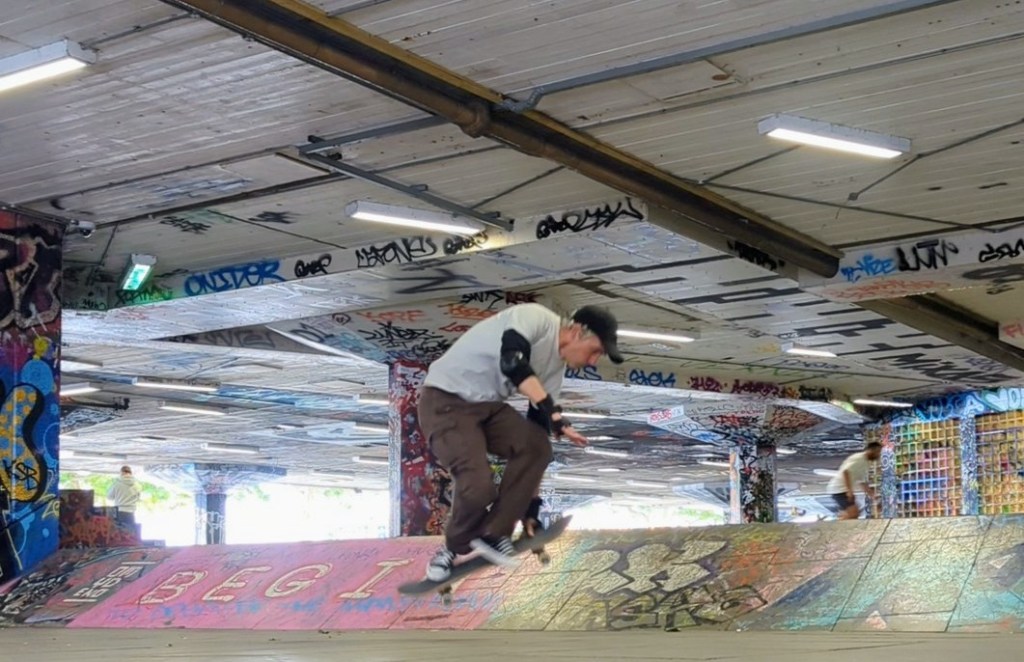
The nervousness on entering such a famous space was there again the other day, just as it was three years ago: a gradual process of adjusting to this new, still quite unfamiliar terrain; finding the right angle to banks that weren’t built with skateboards in mind; working out the speed and limits of the surface and its perimeters. But overriding all this is an intoxication that has nothing to do with the mild and eventually ever-present whiff of weed that (sometimes) hovers around the place. It comes from the awareness that, just in being here, you are skating the Undercroft, and in turn you become part of a remarkable history. That astonishing realization, also, as some passerby stops to take a video of you, that you are the skateboarder, and no longer just a spectator.
 More Than Coping
Leave a comment