To ask whether we live in interesting times is a bit like asking if that bear still shits in the wood. Yes, it still does. And yes, we most certainly do.
In a world of mostly disunited states, Skateistan isn’t one of them. Founded in Kabul nearly twenty years ago, Skateistan is a non-profit that creates skateboard and education projects globally, mainly for children at risk and those impacted by hardship. It sees skateboarding not just as opportunity for creativity and fun, but as a tool for meaningful change. ‘War. Inequality. Climate disaster. Social exclusion’, Skateistan’s recent fundraising campaign lists: ‘In the face of these challenges’, it goes on, skateboarding builds ‘one thing that matters most: resilience.’
How we respond to these global challenges has becoming the most pressing of all questions. But it’s a question that seems all the more challenging when confronted by the inability to affect change. To mention skateboarding and resilience in the same breath, at least in the context of crisis, might sound out of place. Yet Skateistan’s mission suggests that this response is situational. You can’t change the whole world, it appears to say; so what small part of the world can you change?
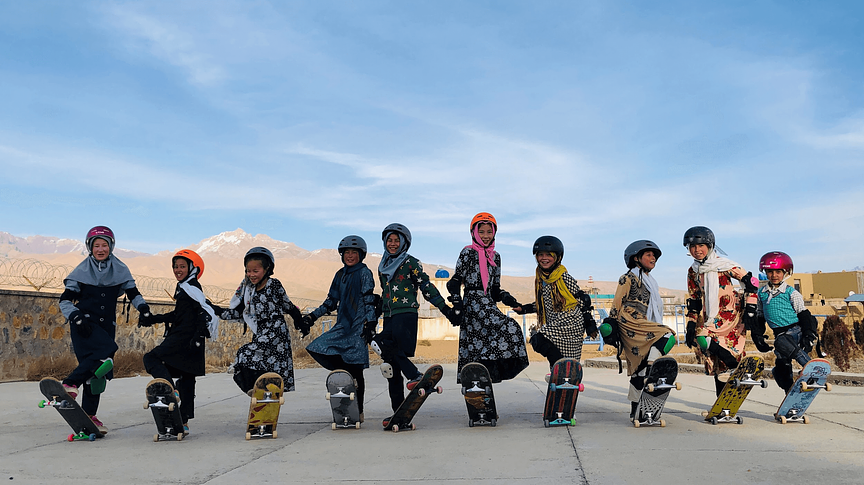
Image: Skateistan.org
The logical response to all-pervasive bad news should be to care. Unlike going off to skate, that sounds like the responsible thing to do. Yet how much we choose not to care is at once equally human, if not equally humane. Some things merit our noise and our protest, but not when they become the source merely of impotent rage or despair. Most of the stuff that outrages us is beyond our immediate power to affect it: that’s why it makes us so angry. You need to know which the right battles are to pick, but also when not to fight at all. As the economist Tim Harford writes on this same score:
When people solemnly declare that this is no time for complacency, what exactly do they suggest as a response? Voting makes a difference… So does political organising. But if your idea of resistance… is actually just a combination of doomscrolling and self-induced insomnia, maybe you should pay more attention to the birdsong and the sunshine.
If this sounds a bit like sticking your head in the sand, it’s not. You won’t find any birds or sunshine down there for starters. But it’s not avoidance, either. Most of our present ills are prefixed by the vicious spiral of negativity: disunion, discord, distrust (the same Dis, in fact, for which Dante named his city in the circles of Hell). Choosing to be positive, by contrast, can be a radical act; the first steps in the building of a different world.
Skateistan is not a state found on a map. It has no say at the UN or NATO. But nor is it a state of denial.
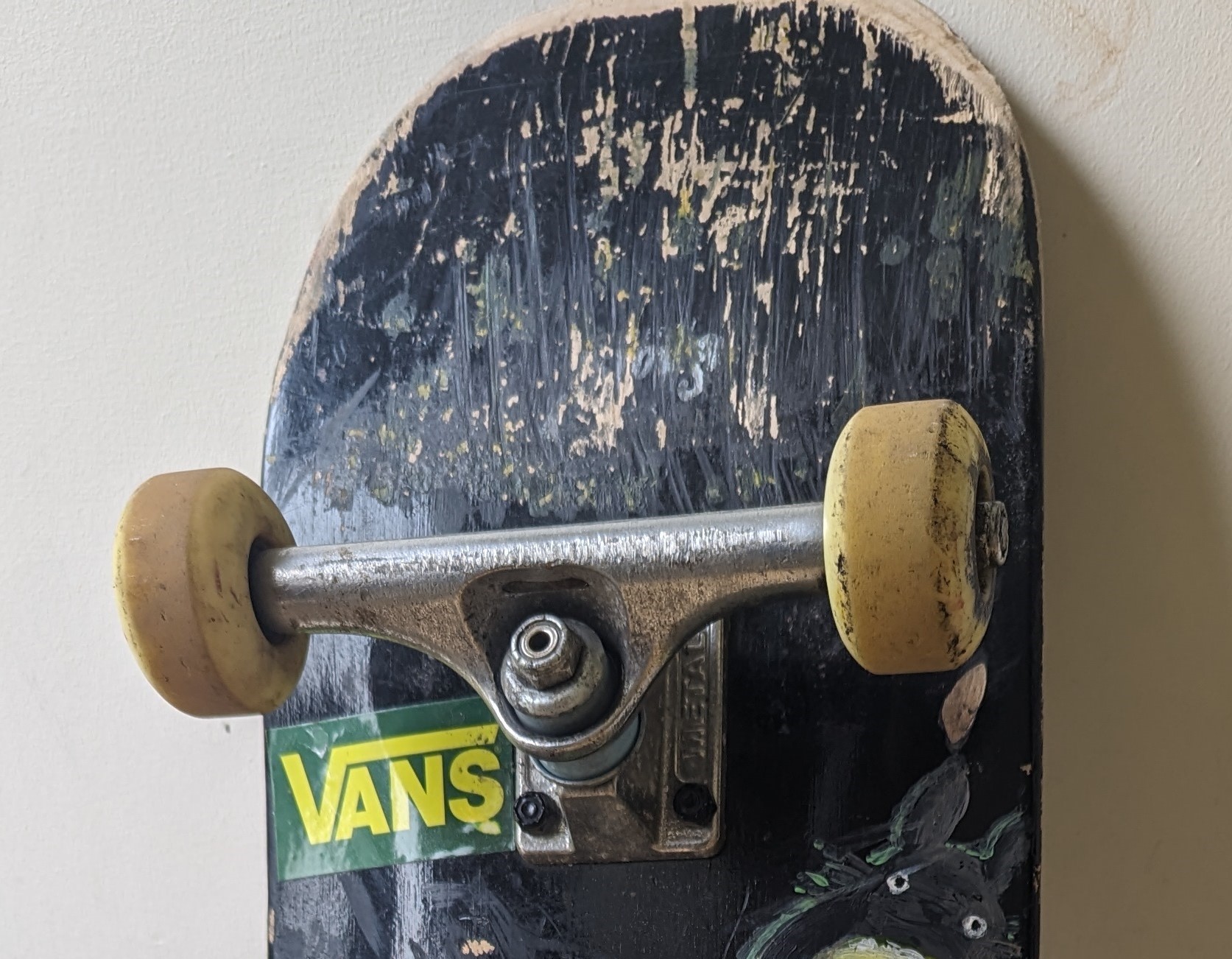
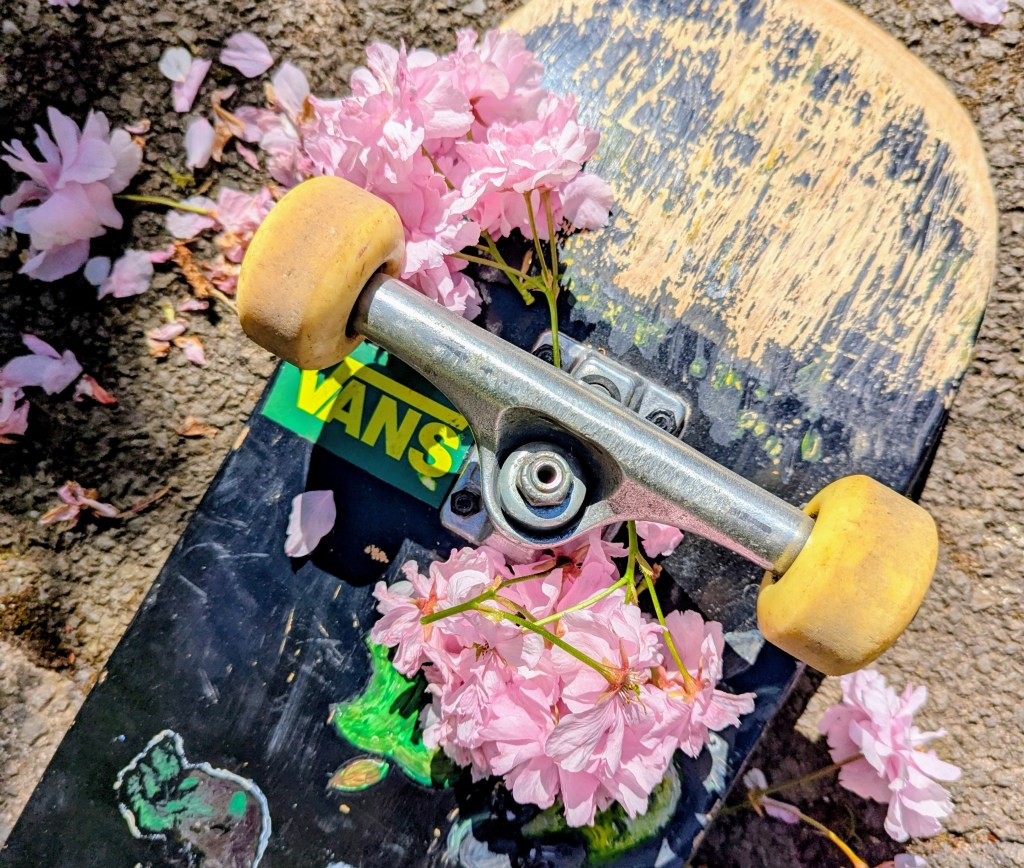
I’m currently up at my house on the campus where I work most of the year. This Tuesday just gone I avoided the news (the very same time, in turned out, that King Charles was addressing the U.S. Congress), and went for my first outdoor skate of the year. Later perhaps than I’d have imagined, but better than never: the waiting sun will outshine us all, in any case, and spring, petro-fascists notwithstanding, is not yet silent. After an overcast day, one oddly and unseasonably cold, the vinyl blue of a cloudless sky summoned me. I pulled on my elbow and wrist pads, laced up my Vans, and grabbed my older board, its stone-scratched nose and tail the trace of prior ventures around this same terrain.
Carrying my board to the edges of the campus and out beyond the treeline, I hopped on and pushed off toward the sunny side of the road, feeling the warmth of the sun on my back (Happy New Year, as skaters sometimes call this first venture out of the winter dark). Beneath me was concrete and tarmac, alternately smooth and grainy; around me shook the young leaves of trees and ice-cream bursts of late cherry blossom. I headed to my favourite car park, invitingly empty after the five o’clock getaway. I broke out into an array of new tricks I’ve been working on: sal flip; 180 ollie; backside boneless. The sun slowly set while the breeze stirred the long grass. At this point in time, I wouldn’t have been anywhere else.
Toward the conclusion of Barbarian Days, William Finnegan describes his experience of writing a report on northern L.A. County, not far from the birthplace he happily remembers, but now a ‘toxic exurban pond’ blighted by gang violence, random stabbings and methamphetamine abuse. Finnegan, often conflicted about his bigger obsession with surfing, seeks to square his pursuit ethically with this violent reality. His answer lies in this same transmutation of reality into a thing of wonder:
This was a cold new world, all stark downward mobility. I found the reporting, which took several months, deeply disturbing, and I tried to take occasional breaks, and to time those breaks to coincide with promising surf forecasts… Those mornings [of surfing] were both cathartic and Edenic. Bougainvillea spilled down chalky cliffs. The kelp, the eelgrass, the gentle blue waves. Seals barked, gulls cried, dolphins breached. I felt spiritually poisoned – some acrid cocktail of anger, sadness, hopelessness – by the story I was working on. Surfing had never made more sense.
Surfing might be a ‘break’, but it is not the villain in this piece. That role goes to the caustic human action and the myriad injustices that make surfing a necessary response. To suggest then, as Finnegan does, that in a toxic world surfing makes sense points to so much more than a desire for oblivion, or even for a hiatus in reality. He implies that surfing, or indeed skateboarding, might be the antidote to the toxin; to see it not so much as a band-aid, but the inverse side of the equation.
We live now in a world, moreover, in which the physical body can be rendered functionally irrelevant; one where thought, creativity and knowledge can be outsourced to software, and in which the human origins of this blog post itself might be called into question. In such a world we look not only for reasons to live, but more specifically, the things that confirm and affirm us. Strip everything else away and we are left with the pursuit of the authentic gesture: the physical action that cannot be taken away from us, that at once speaks uniquely of us, and at the same time adds to, rather than subtracts from, the beauty and diversity of the world.
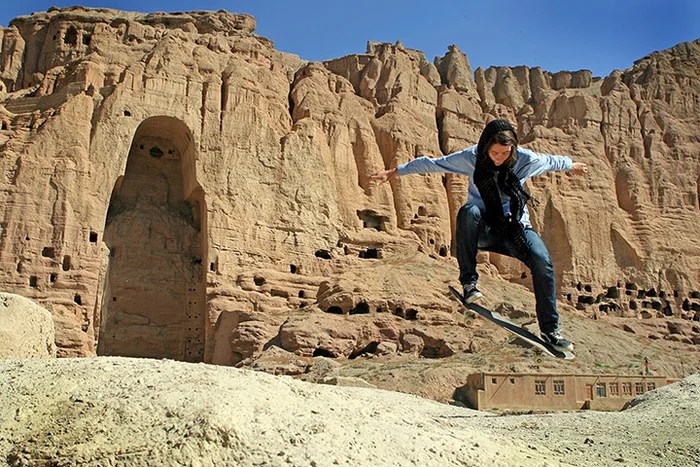
Image: Skateistan.org
One can of course find this in any number of things: the slap of paint on a canvas, or of running shoe on road; the scrape of a violin bow across strings. I just happen to find it in the scrape of urethane wheels on a hard floor; and then to evoke this, as I’m trying here, through the smack of fingers on my keyboard, or the scratch of pen on the page.
For some, the sight and noise of kids tearing up the streets on skateboards offers an image and soundscape more apocalyptic than utopian. But that first impulse to surf on concrete and tarmac, to create a beautiful and authentic gesture not just within but via the urban environment, is what gives skateboarding its special quality. It is, in its way, a refusal to simply lie down and take it – a response of hope against the logical course of despair.
If Skateistan is a state of denial, then it is only to deny the negative in existence, not existence itself. Which is to say, if it isn’t already clear, that those kids on boards are not the problem. In a world which fails to see them as citizens, Skateistan is part of the solution. All meaningful change starts with a small push.
skateistan.org / #neverstoppushing
 More Than Coping
Leave a comment