I’m bad at holidays at the best of times, which is awkward in all sorts of grammatical ways. Awkward too for my family, especially when I drag my feet for so long that I end up dragging them to the same place as last year. Preferably somewhere English. With waves.
Don’t get me wrong: I don’t dislike holidays. I just don’t like the pressure of having to make a choice.
And I also don’t have a bucket list.
It’s three years now since I took up skateboarding, two years almost to the day that I created this blog. Neither of these events were on a list. I’ll be turning 55 this autumn. I won’t mark that occasion with a list either.
Does this make me sound like a stick-in-the-mud? Perhaps. But as Sherlock Holmes was always keen to point out, there’s mud, and there’s mud: this blog is, after all, about trying to do something at once unexpected, unlikely and, at my age, possibly unadvisable. Isn’t everything I’ve written here about the significance, as we move into the later period of life, of changing things up?
Some context here. My fondness for the staycation is not born of some patriotic devotion to my native isle, nor of any aversion to travel as such (though I do hate airports). If I’m keen to retrace my holiday steps, it’s actually because I want to go back to do more surfing: for me, at least, the inevitable if (from an evolutionary perspective) backward journey after getting onto a skateboard first. (For the record, if I had to compare experiences, I’d suggest that surfing is like skateboarding during an earthquake. But more of that another time).
If you’ve ever holidayed in a surf resort, at least one on the relatively benign English coast, you’ll have noticed the constant landscape of surf schools plying their trade within the whitewater. Dads, mums, grandparents, couples, kids – a year ago I joined the throng, all of us donning the school bib and the hired wetsuit that, by definition, should not be ill-fitting yet never looks quite right; all of us committed to that one hoped-for moment, where we will finally manage to stand up on that oversized board and catch that half-decent wave.
Returning to my surf school every other morning might have had a repetitive feel, if not for the fact that the faces and bodies around me kept changing. I asked my instructor how many of these newbies came back for more. For most, it turns out, that first wave will usually be the last, which might be why some of these schools also have their resident photographers, ready to capture that once-only Instagrammable ride. The list won’t wait for a second try.
The bucket list isn’t just cool: it has kudos. Stripped of its original connotations, appropriated and commodified as a lifestyle mission, the list also speaks to the current scientific thinking that novelty is good for the ageing body and brain. Since I’ve spent time making that same point earlier in this blog, it’s not a notion I’m going to contradict. But the question is at what point the amount of new things adds up to nothing much at all. To be a ‘newbie’, after all, would suggest at least some idea of a next stage. But if you do something only once, how can you have even started?
It’s a philosophical puzzle for which German has the best answer: Einmal ist keinmal – ‘once is never’ – the opposite, perhaps, to that obnoxious English notion of been there, done that, the vastness of the world reduced to a series of snapshots. To such a claim I usually find myself asking but what exactly did you do? Any singular event – the wave caught, the bungee jumped, the sky dived – begs the question whether, in its newness and fleetingness, it ‘happened’ at all. This is more common sense than mysticism, since how can you recognize what something is – recognize literally meaning ‘to know again’ – if this is your first and only try?
The bucket-lister’s reasonable response to this fancy wordplay is that the clock is ticking. But if I say that I’m going to go back to the same beach to surf, just like I’m going to stick with skateboarding, my point is the same: I don’t have enough time.
This might sound counter-intuitive. But like tourism, which makes the transitory and changeable its objective, bucking-listing risks swapping a range of experiences for actual experience. Surfing, even more than skateboarding, epitomises this dilemma: beyond simply staying on the board, the real challenge – unless you have daily access to a beach with a point break – is that you can mistake doing it for ages for barely having done it at all. Tom Vanderbilt’s book Beginners notes this same tendency among holiday surf students who, like me, come back for more the following summer, convincing themselves they have two years’ experience when in fact they have less than two weeks’, or more likely two days’ – which, in terms of actual time on the board, might be around two hours.
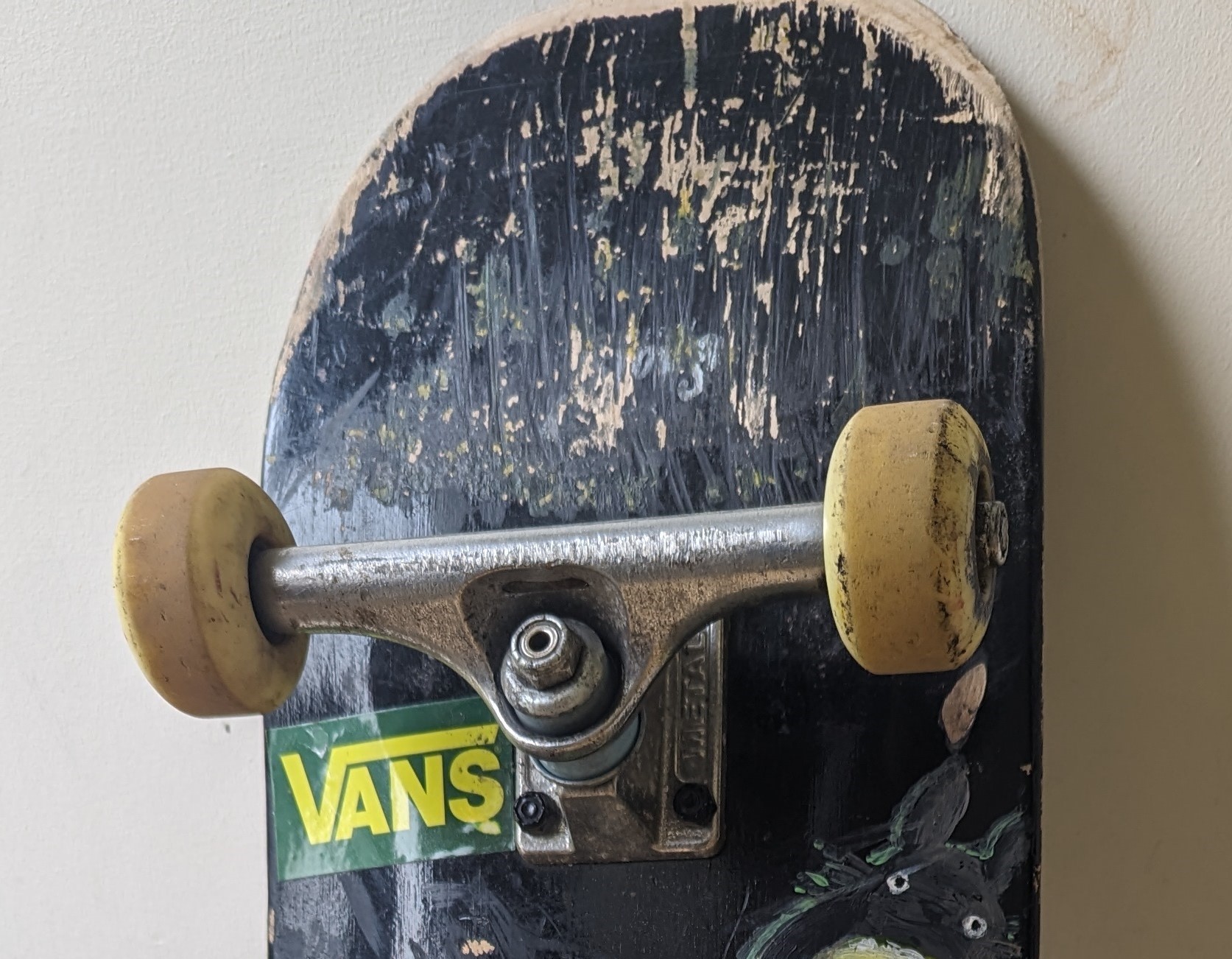
Skateboarding presents more opportunities for most, but even here pedigree might be wildly overstated. Having done the maths, I find I’ve clocked up around 300 hours on a skateboard in three years, which in average session-length would equate to something like one session every twelve days. Just eighty days in total out of a possible eleven hundred that I could have spent skateboarding; or in sheer hours of board time, less than a fortnight. Not all the cheese in the world would let me dream I was a surfer; yet put this way, even my claims to being a skateboarder seem pure Red Leicester. The truth is that, a bit like the Formula Four wheels I’ve had on my board for two whole years, I’ve not really scraped the surface.
Contrary to how it might sound, I’ve no problem at all with any of those granddad surfers, or the grandma paragliding across the Amazon, or with whatever somebody chooses to do once their hair turns grey. There’s nothing ridiculous about anyone doing anything, whatever the age. The only ridiculous thing – at any age – is to shout about something you only did once. Why not get really good at something instead? Sometimes it pays to stick more than twist.
Novelty is nothing without continuity; continuity is nothing without innovation. And that line between staying put and moving on, it turns out, is less a division, and more a tightrope: or, indeed, a coping edge. As with most things, in skateboarding or elsewhere, balance turns out to be the key.
 More Than Coping
Leave a comment