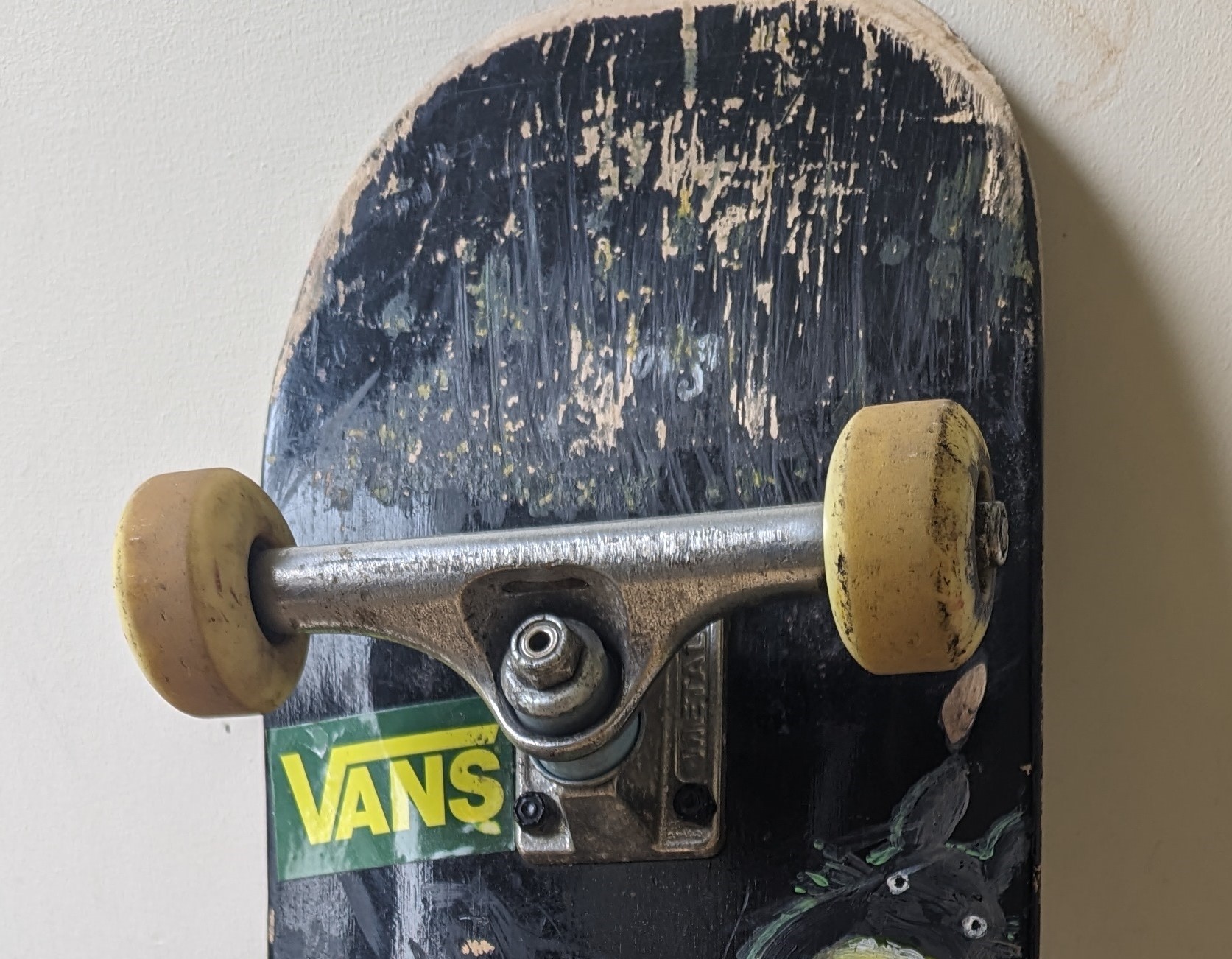
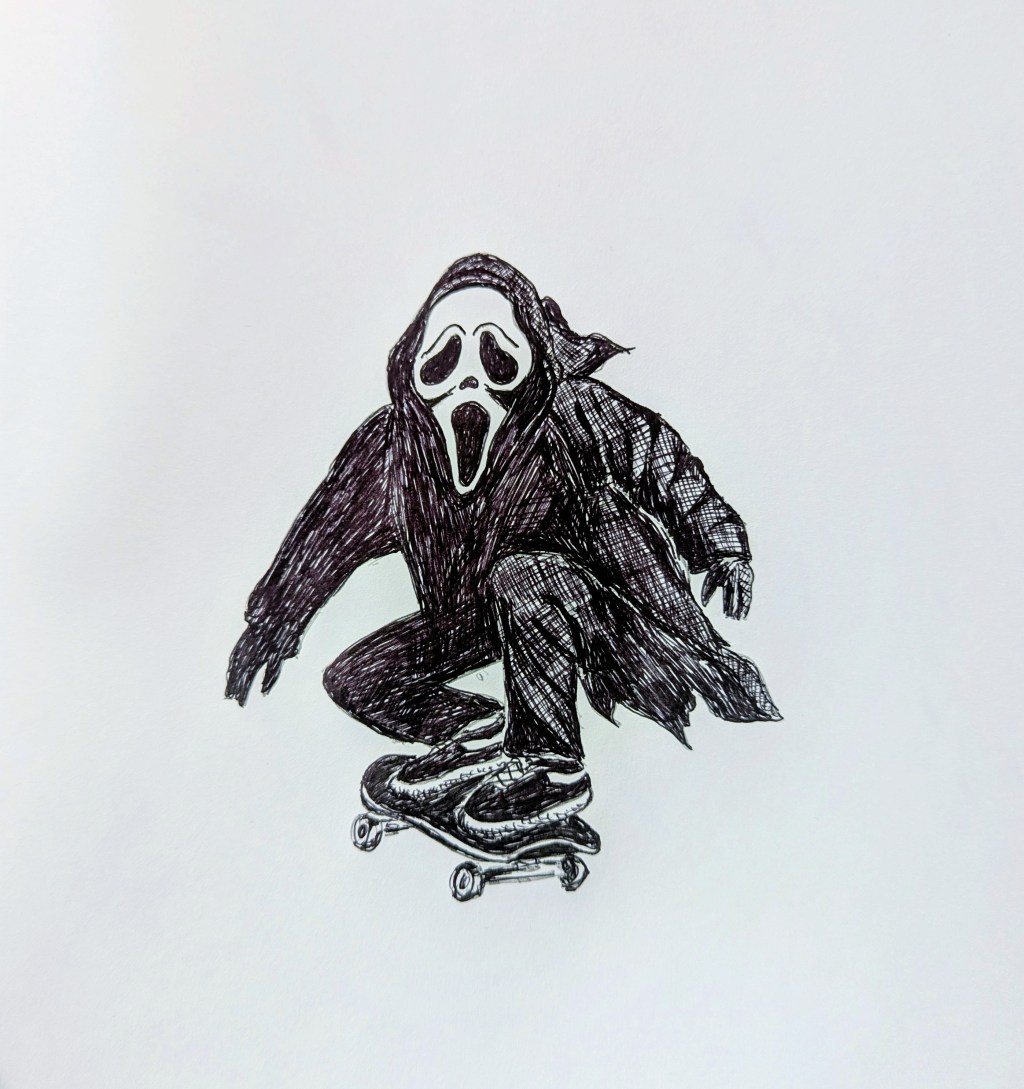
Be afraid. Be very afraid.
If we believe Marc Andersen and Mathias Clarsen from Aarhus University, this might be solid advice. What they call ‘recreational fear’, the pursuit of fearful experience for pleasure, turns out to be a multipurpose life hack: an adaptation to stress, an experimentation with limits, or a coping mechanism. Supposedly, fans of horror movies (or if they were like me, fans of the boardgame Pandemic) better endured the Covid-19 lockdowns by turning fictional terror against real-world anxieties. Perhaps the persistent fascination amongst the young for ever-more scary films is one symptom of our ever-more scary and uncertain world. Or maybe it’s just one way to feel alive.
What I do know is that, in the UK at least, lockdown was also a boom time for skateboarding, and maybe not just because of its amenability to social-distancing rules. There’s a mental toughness and discipline, for one thing, in doing anything in isolation. But there’s also the particular experience skateboarding generates. A while ago in this same blog I talked about Skateistan.org, a non-profit that uses skateboarding to promote, amongst other things, ‘resilience’ in displaced and migrant communities. The idea that a small board on wheels might promote resilience in a crisis seems a stretch. But that’s only when we ignore how skateboarding, at some level, always includes the likelihood of fear. And it’s in accepting this fear, rather than in pretending it doesn’t exist, that we understand skateboarding’s potential as a training ground for life.
This is one reason to find the sight of young children throwing themselves into skateboarding so gratifying – especially if it also means their parents, should they be around, aren’t helicoptering after them like permanent pillows. At nearer the opposite end of the developmental scale, of course, as a recently turned 55-year-old, I don’t have quite the same excuse. Or do I?
I’ve said before that if the mid-life crisis exists, it’s often a very real crisis of choice and action in the face of figurative or often actual redundancy. It’s also the point at which one’s sense of self, knowledge and in turn capacity for change has ossified. In other words, it’s the reason many 55-year-olds can seem as boring as shit. And while I couldn’t care less how I ‘seem’, the prospect of being bored as shit – the most obvious outcome of that developmental conservatism – fills me with a reasonable dread.
And that’s why I need to get myself afraid.
When I started this blog, my daughter, who got me into skateboarding in the first place, was still only thirteen. Having just turned sixteen, she’s getting to the age when she won’t need me for much anymore, which includes those increasingly sporadic car rides to the skatepark. And if I’m to avoid being the helicopter parent I’ve always pledged not to be, that’s all fine. But that means too that I’ll soon, in an everyday sense of taking care of her, cease to be responsible.
My partner has always been a bit circumspect about these skatepark trips, especially after one of them – when she and our daughter, in this case, were at home on the other side of the country – left me stranded with a broken ankle. From one point of view, and especially in light of such an accident, skateboarding might seem the opposite of responsible adult behaviour. Perhaps, at this point, it would have been time to grow up.
But what this notion misses – and unlike my psychotherapist partner, who rarely misses anything – is the role of fear. Because how do you square irresponsibility with the fact that, every time I go out with my skateboard, I never fail to feel slightly afraid – and not just for fear of further injury. It’s a fear more of the effort and application I know will be involved, and of the technical and physical challenge every new trick represents; fear of the space of a skatepark itself, with its unknown rises and drops, and all its necessary obstacles. A fear without which, like a scary movie without the scares, skateboarding wouldn’t be anything like as exhilarating.
Maybe when you lose your responsibilities, the only real responsibility is to yourself. My partner, incidentally, recently suggested I suffer from anhedonia; literally the inability to feel joy, or what the professors behind the recreational fear model call ‘emotional flatlining’. She might be right, if only in a situational respect: in other words, I experience this absence of joy only in the absence of fear. But insofar as, from a certain point in life, that same situation threatens to becomes chronic, I need to find a medicine that works.
So if my partner now tolerates my occasional sorties armed with a skateboard, it’s perhaps because she sees it more clearly; neither as an evasion of responsibility or the easy option, but as my own confrontation with life’s fears, and my own personal way of coping.


Leave a Reply